Amazon Rainforest Dieback: Emerging Risks, Feedback Loops, and Scenario-Based Projections
by Daniel Brouse and Sidd Mukherjee
June 3, 2026
Framing the Question
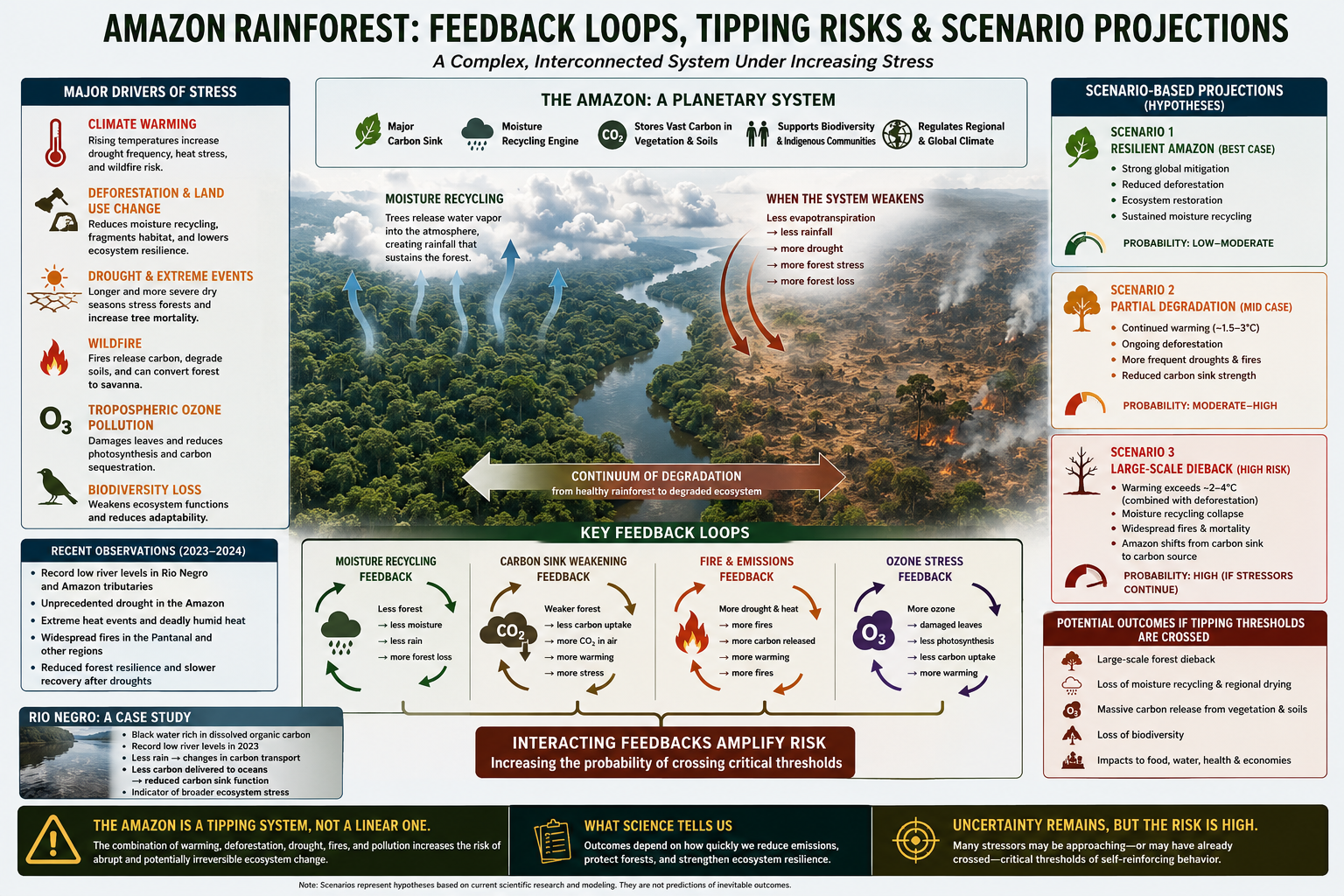
The Amazon rainforest is widely recognized as one of Earth’s most important climate-regulating ecosystems. It functions as a major carbon sink, stores vast quantities of carbon in vegetation and soils, recycles moisture across South America, and supports extraordinary biodiversity.
A growing body of research suggests that the interaction of climate warming, deforestation, drought, wildfire, and atmospheric pollution may be reducing the resilience of the Amazon system. While large-scale Amazon collapse has not occurred, several studies identify the rainforest as a potential climate tipping element whose stability could be compromised under continued environmental stress.
The central scientific question is not whether the Amazon faces increasing risk—it clearly does—but rather how close the system may be to critical thresholds and how multiple stressors interact to influence that risk.
Observations
Several observations have raised concerns among researchers:
- Severe droughts have become more frequent in portions of the Amazon Basin.
- Record-low river levels were observed in several Amazon tributaries during 2023, including the Rio Negro.
- Elevated temperatures and reduced rainfall have increased wildfire risk in parts of Brazil.
- Some studies report declining resilience in portions of the rainforest, including slower recovery following drought events.
- Deforestation continues to reduce forest cover and disrupt regional moisture recycling.
These observations do not demonstrate imminent Amazon collapse. However, they are consistent with trends expected in systems experiencing increasing environmental stress.
Scenario 1: Moisture-Recycling Feedback and Amazon Dieback
One widely studied hypothesis involves the weakening of the Amazon’s internal moisture-recycling system.
The rainforest generates a significant portion of its own rainfall through evapotranspiration. Trees release water vapor into the atmosphere, helping sustain regional precipitation. Continued deforestation reduces this moisture recycling, potentially extending dry seasons and increasing drought stress.
Under this scenario:
Deforestation → Reduced evapotranspiration → Less rainfall → More forest stress → Additional forest loss
Climate warming may amplify this process by increasing temperatures, evaporative demand, and drought frequency.
Several modeling studies suggest that combined warming and deforestation may lower the threshold at which large-scale forest degradation becomes possible. The precise threshold remains uncertain and varies substantially among models.
Scenario 2: Carbon Sink Weakening
A second hypothesis involves a gradual weakening of the Amazon’s carbon-storage function.
Historically, the Amazon absorbed substantial quantities of atmospheric carbon dioxide. However, increasing heat stress, drought, fire activity, and ecosystem degradation may reduce this capacity.
Under this scenario:
Reduced forest productivity → Lower carbon uptake → More atmospheric CO₂ → Additional warming → Further forest stress
This represents a positive feedback loop, although the magnitude and timing remain active areas of research.
Importantly, a weakened carbon sink does not necessarily imply complete forest collapse. Partial reductions in carbon uptake could still have significant implications for global climate stabilization efforts.
Scenario 3: Tropospheric Ozone Amplification
Another emerging area of research examines the role of ground-level (tropospheric) ozone.
Unlike stratospheric ozone, which protects life from ultraviolet radiation, tropospheric ozone can damage plant tissues and impair photosynthesis.
Several studies have found that ozone exposure can:
- Reduce photosynthetic efficiency.
- Lower net primary productivity.
- Increase vulnerability to drought and heat stress.
- Reduce carbon sequestration capacity.
Under this hypothesis, ozone acts as a stress multiplier rather than a primary driver. Its effects may become increasingly important when combined with warming, drought, wildfire smoke, and land-use change.
The degree to which ozone contributes to large-scale carbon-sink decline remains an active research question.
Rio Negro as a Case Study
The Rio Negro provides an interesting example of how climate and carbon-cycle processes may interact.
The river’s dark coloration results from high concentrations of dissolved organic carbon derived from surrounding forests. During severe drought conditions, river discharge declines substantially, potentially altering carbon transport processes.
Researchers continue to investigate how changes in precipitation, drought frequency, and river flow influence regional carbon cycling and ecosystem resilience.
While these observations are scientifically important, direct links between individual river events and large-scale Amazon tipping behavior remain the subject of ongoing study.
Climate-Risk Interpretation
From a systems perspective, the Amazon is best viewed as a coupled climate–ecological system.
The concern is not any single stressor in isolation. Rather, the risk emerges from interactions among:
- Climate warming
- Deforestation
- Drought
- Wildfire
- Atmospheric pollution / ozone
- Carbon-cycle disruption
- Biodiversity loss
These interacting forces create nonlinear behavior in which risks may increase more rapidly than expected from any individual factor alone.
Conclusion
Current evidence does not demonstrate that Amazon rainforest collapse is inevitable. However, a growing body of research indicates that the system’s resilience may be declining under the combined influence of climate warming and land-use change.
Several scenario-based projections suggest that continued warming, ongoing deforestation, and additional environmental stressors could increase the probability of large-scale forest degradation during the coming decades.
The precise timing, magnitude, and interactions of these processes remain active areas of scientific investigation.
Nevertheless, a growing body of observational evidence suggests that the risk is substantial. Multiple climate, ecological, and socio-economic systems are exhibiting behaviors consistent with increasing stress, declining resilience, and the emergence of self-reinforcing feedback mechanisms.
While significant uncertainties remain regarding specific thresholds and outcomes, there is increasing concern that some underlying stressors may be approaching—or in certain cases may have already crossed—critical tipping points beyond which system responses become increasingly difficult to predict, manage, or reverse.
The central scientific challenge is therefore not simply determining whether such thresholds exist, but identifying where they lie, how rapidly they are being approached, and how interacting feedbacks may amplify risks across interconnected systems.
Sources and Further Reading
Primary References
Brouse, D., & Mukherjee, S.
Tipped Tipping Points, Feedback Loops, and the Domino Effect
http://membrane.com/global_warming/Domino-Effect-Tipping-Points-Toppled.html
Discusses interacting climate tipping points, feedback loops, and cascading system behavior within coupled climate–economic systems.
Amazon Rainforest Stability and Tipping Risk
Nature (2026)
Robust Projections of Risks to the Amazon Rainforest
https://www.nature.com/articles/d41586-026-01158-8
Overview of recent research examining Amazon resilience, tipping-point risks, and future forest stability under climate warming and land-use change.
Ozone and Tropical Forest Productivity
Nature Geoscience (2024)
Reduced Productivity and Carbon Drawdown of Tropical Forests from Ground-Level Ozone Exposure
https://www.nature.com/articles/s41561-024-01580-5
Examines the effects of tropospheric ozone on tropical forest productivity and carbon sequestration.
Ground-Level Ozone and Carbon Drawdown
Carbon Drawdown and Ground-Level Ozone Research Notes
http://membrane.com/global_warming/notes/Carbon-Drawdown-Ground-Level-Ozone.pdf
Review and synthesis of literature examining the relationship between ozone pollution, plant productivity, and carbon-sink performance.
Amazon Moisture Recycling and Forest Resilience
Science Panel for the Amazon
Amazon Assessment Report
https://www.theamazonwewant.org/amazon-assessment-report-2021
Comprehensive assessment of Amazon climate, ecology, biodiversity, hydrology, and emerging risks.
Climate Change Assessments
Intergovernmental Panel on Climate Change (IPCC)
Sixth Assessment Report (AR6)
https://www.ipcc.ch/assessment-report/ar6
Authoritative assessment of climate science, impacts, adaptation, and mitigation.
Monitoring and Observational Data
Brazilian National Institute for Space Research (INPE)
Provides satellite monitoring of Amazon deforestation, drought, wildfire activity, and environmental change.
Copernicus Climate Change Service
Global climate monitoring, temperature records, atmospheric observations, and climate indicators.
National Oceanic and Atmospheric Administration (NOAA)
Climate observations, ocean monitoring, weather extremes, and long-term environmental datasets.
Important Note on Scenario-Based Projections
Several discussions in this paper—including Amazon dieback, carbon-sink weakening, ozone-amplified feedbacks, and coupled climate–economic instability—should be understood as scenario-based projections and working hypotheses derived from published research, observational trends, and systems modeling. They describe plausible future pathways under continued environmental stress, not deterministic forecasts or inevitable outcomes.
The precise timing, magnitude, and interaction structure of these processes remain active areas of scientific investigation. However, a key and increasingly important feature of the observational record is that multiple climate and ecological indicators in the Amazon appear to be shifting into what can be described as “jerk” behavior—that is, dynamics in which not only the state of the system is changing, but the rate of change itself is changing. In mathematical terms, this corresponds to increasing higher-order derivatives of system behavior, where acceleration is no longer stable but itself accelerates over time.
In practical terms, jerk behavior is observed when systems transition from relatively smooth or predictable trajectories into regimes characterized by rapidly compounding variability, abrupt shifts, and feedback amplification. In the Amazon context, this is suggested by signals such as increasing volatility in precipitation extremes, faster transitions between drought and recovery states, and weakening resilience following disturbances such as heat stress or fire events.
This type of behavior has direct implications for modeling. Most climate–ecological models are calibrated on assumptions of quasi-stationary relationships or slowly varying parameters. When a system enters a jerk-dominated regime, those assumptions begin to break down. As a result, model skill can degrade because the underlying system is no longer operating within the parameter space on which historical relationships were trained. In effect, the system is moving faster than the models can recalibrate, and feedback loops may become more dominant than externally forced trends.
Taken together, this suggests that the Amazon system may be transitioning into a regime where predictive uncertainty increases not only because of data limitations, but because the governing dynamics themselves are becoming more nonlinear, more coupled, and more sensitive to initial conditions.
While substantial uncertainty remains regarding thresholds and coupling strength, the convergence of observational and modeled evidence indicates elevated risk of crossing critical transitions. In such regimes, system behavior may become increasingly dominated by self-reinforcing feedbacks, reducing predictability and limiting the effectiveness of gradual mitigation once key boundaries are exceeded.
* Our probabilistic, ensemble-based climate model — which incorporates complex socio-economic and ecological feedback loops within a dynamic, nonlinear system — projects that global temperatures are becoming unsustainable this century. This far exceeds earlier estimates of a 4°C rise over the next thousand years, highlighting a dramatic acceleration in global warming. We are now entering a phase of compound, cascading collapse, where climate, ecological, and societal systems destabilize through interlinked, self-reinforcing feedback loops.
Tipping points and feedback loops drive the acceleration of climate change. When one tipping point is toppled and triggers others, the cascading collapse is known as the Domino Effect.