Climate Change Threshold-Driven Dynamics
A Unified State-Space Framework for Accelerating Earth System Energy Redistribution
Graduate Edition
Also see the public-access overview: Threshold Dynamics: A New Way to Understand Earth’s Accelerating Climate System
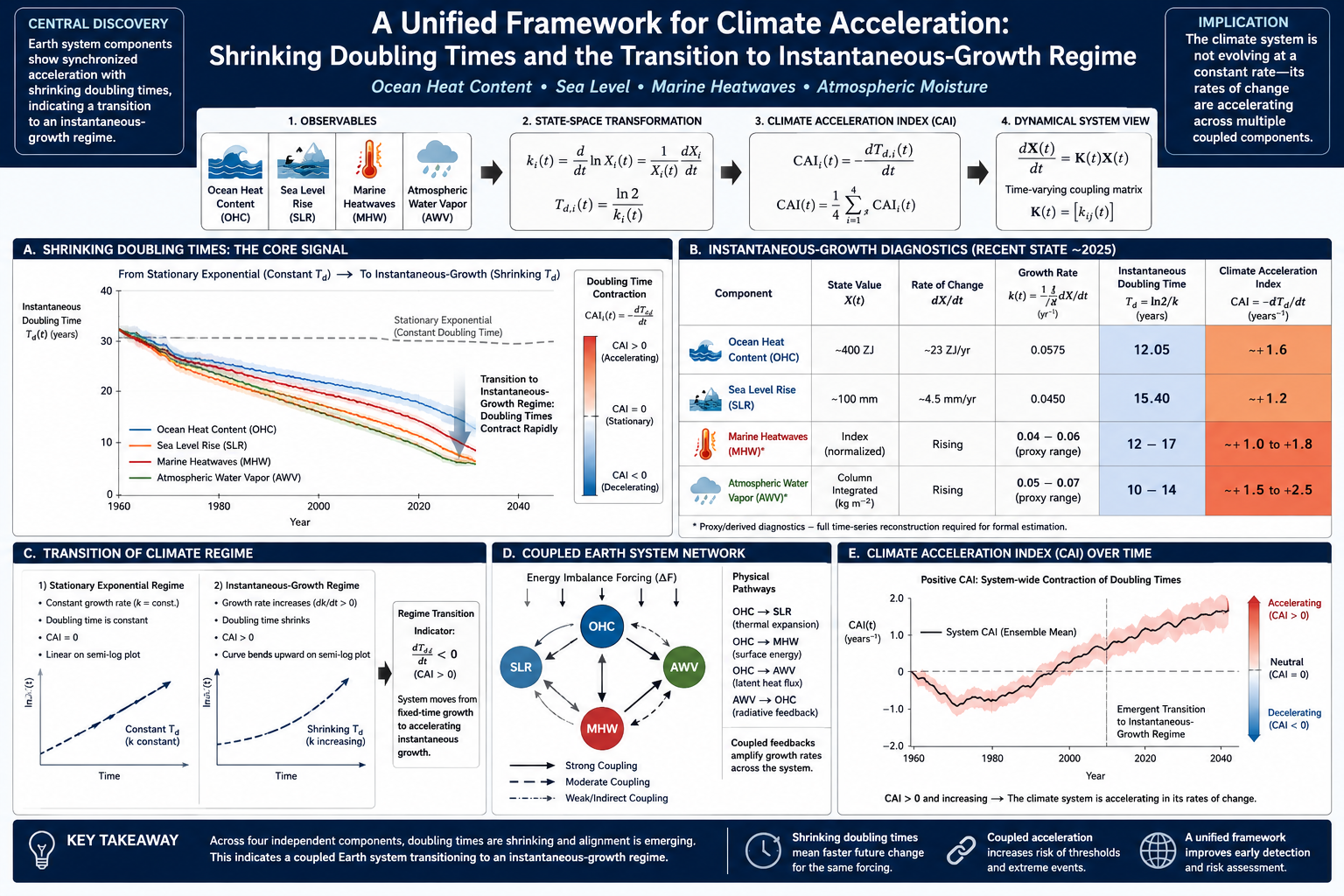
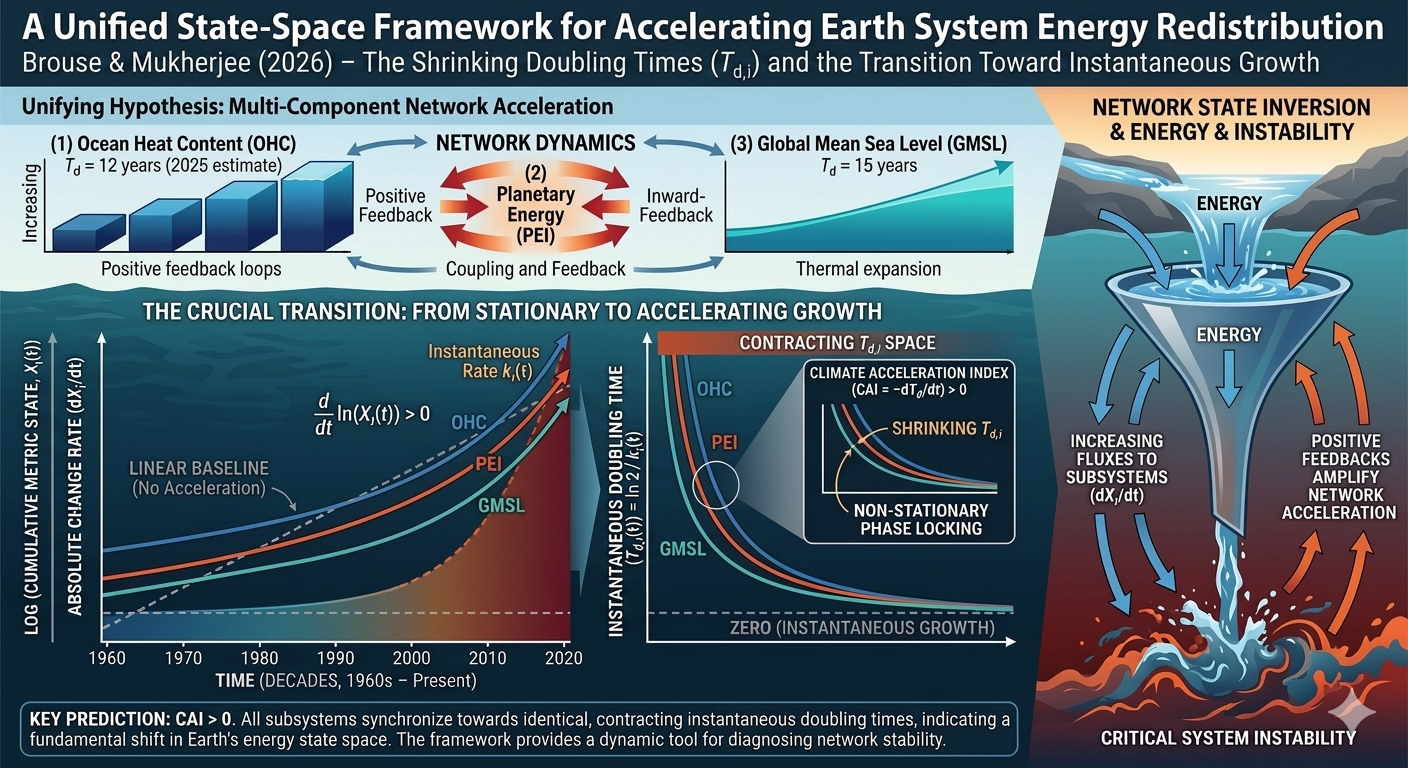
The Earth's climate system is undergoing a regime shift away from historically near-linear behavior toward accelerating nonlinear and compounding dynamics, characterized by systematically shrinking effective doubling times and the emergence of instantaneous-growth dynamics across coupled Earth system components.
Overview of Climate Regime Shift Analysis
From the Industrial Revolution through much of the 20th century, several slowly evolving climate-related indicators exhibited characteristic response times on the order of a century (~10² years), although these vary substantially by variable and data availability. By the 2020s, multiple independently observed Earth system components show accelerated trends with effective timescales in some cases compressing toward decadal scales (~10¹ years), particularly in high-frequency or feedback-sensitive variables.
This progression can be interpreted as a multi-stage contraction of characteristic timescales, consistent with an approximate sequence of successive halving steps when comparing early industrial-era behavior to contemporary observations across multiple Earth system indicators. This description is heuristic and reflects aggregated, multi-variable changes across distinct but coupled components of the Earth system rather than a single uniform scaling law.
By 2025, analysis moved beyond purely retrospective exponential fitting toward a state-space formulation of system evolution. The framework represents a shift in perspective. Rather than focusing on individual climate indicators—such as global mean temperature, sea surface temperature, ocean heat content, or sea level rise—it examines the behavior of the Earth system as a whole. As the higher-order dynamics (including the "jerk," or third derivative) of individual subsystems become increasingly nonlinear and accelerative, those individual indicators become less useful as standalone measures of the system's evolution. The objective is therefore to characterize the collective dynamics of the coupled Earth system rather than any single climate variable.
One of the central metrics, for example, is the Contraction Acceleration Index (CAI):CAI(t) = − d/dt [ (1/4) ∑ᵢ₌₁⁴ (ln 2 / kᵢ(t)) ]
which measures the rate of change of the ensemble-mean doubling time across key Earth system components.
This equation quantifies the rate at which the instantaneous doubling times of multiple coupled Earth-system components are contracting.
Multiple independent climate indicators now suggest rates of change that exceed those observed throughout most of the modern instrumental record, with evidence of coordinated acceleration across interacting subsystems. While the paleoclimate record contains instances of abrupt regional and global transitions, there is no direct geological analog for a sustained, multi-variable, high-resolution acceleration pattern across the full Earth system as observed in contemporary datasets.
If these trends persist, they may represent a transition into a qualitatively distinct dynamical regime characterized by strongly coupled, rapidly evolving Earth system feedbacks operating on decadal or shorter timescales.
Daniel Brouse¹ and Sidd Mukherjee²
July 2026
¹Independent Climate Researcher, Economist
²Physicist
Executive Summary
The Earth’s climate system is undergoing a clear regime shift away from historically linear behavior toward accelerating nonlinear and compounding dynamics characterized by systematically shrinking effective doubling times.
Multiple independent Earth system indicators demonstrate synchronized acceleration, with converging evidence that growth rates are increasing across coupled components of the climate system.
Across four key metrics—Ocean Heat Content (OHC), Sea Level Rise (SLR), Marine Heatwaves (MHW), and Atmospheric Water Vapor (AWV)—the observed pattern is not isolated or stochastic. Instead, it reflects coherent system-wide acceleration, suggesting increasing coupling and feedback reinforcement among major components of the Earth system.
Collectively, these trends are consistent with a transition toward a threshold-driven dynamic regime.
Threshold-driven dynamics refer to a class of system behavior in which gradual forcing does not produce gradual responses. Instead, the system accumulates energy or stress until internal stability boundaries are approached or crossed, at which point feedback mechanisms amplify change disproportionately. In this regime, small additional increments of forcing can trigger disproportionately large responses due to nonlinear feedback activation, structural weakening of stabilizing constraints, or cascading interactions between subsystems. Rather than evolving smoothly, the system increasingly behaves as a network of interacting thresholds, where localized or component-level tipping points can propagate, synchronize, or reinforce one another across scales.
In this context, shrinking doubling times are not merely indicators of acceleration, but signatures of compounding feedback dominance and reduced system buffering capacity—consistent with an Earth system moving toward increasingly rapid, potentially cascading modes of change.
Introduction
Shrinking Doubling Times and the Transition Toward Instantaneous Growth in the Earth System
The Earth system is commonly described through long-term trends in temperature, ocean heat content, sea level, and extreme event frequency. These trends are typically represented using linear rates or, in some cases, stationary exponential growth assumptions. While useful for first-order characterization, these representations implicitly assume that the underlying growth dynamics of the system are time-invariant.
However, increasing observational evidence suggests that multiple components of the Earth system are not only changing in magnitude, but also in the rate at which they change. This distinction is critical: it implies that the Earth system may be transitioning from a regime of approximately stationary growth toward one characterized by non-stationary, time-dependent acceleration.
A key diagnostic for this transition is the instantaneous doubling time, defined as:
T_d(t) = ln(2) / k(t) = ln(2) / (d/dt [ln X(t)])
where X(t) represents a climate state variable such as ocean heat content, sea level, or atmospheric moisture. Unlike traditional doubling-time estimates derived from fitted exponential trends, this formulation is fully time-local and does not assume stationarity in the growth rate.
Within this framework, the central question is not whether a variable is increasing, but whether the timescale of increase itself is changing over time.
If the effective growth rate k(t) increases, then the doubling time Td(t) necessarily decreases. This leads to a fundamental diagnostic shift: the Earth system is no longer characterized by fixed exponential time constants, but by evolving temporal scales of change.
This behavior can be interpreted as a transition from:
- Trend-dominated dynamics, where rates are approximately constant
to - growth-rate dominated dynamics, where the rate of change itself evolves
In this latter regime, the system is more naturally described as a state-space process with time-dependent growth operators, rather than a static parametric model.
Recent observational reconstructions of ocean heat content, sea level rise, atmospheric moisture, and marine heat extremes suggest that these systems may exhibit partially synchronized changes in their instantaneous growth rates. This raises the possibility that Earth system components are not evolving independently, but are instead embedded in a coupled structure governed by a shared energy imbalance.
In this context, the concept of a Climate Acceleration Index (CAI) emerges as a reduced-order diagnostic of system-wide behavior, defined through the rate of contraction of doubling times:
CAI(t) = - d/dt [T_d(t)]
A positive CAI indicates that the system is transitioning toward shorter characteristic growth timescales, consistent with accelerating dynamics in the underlying state variables.
This study develops and applies a unified framework for diagnosing these changes across multiple Earth system components. By transforming observables into instantaneous growth-rate space, we examine whether the climate system is best understood as a collection of independently evolving trends, or as a coupled dynamical system undergoing coordinated temporal acceleration.
The central hypothesis explored here is:
The Earth system is undergoing a regime transition in which growth processes are no longer characterized by stationary timescales, but by continuously evolving instantaneous doubling times reflecting nonlinear energy redistribution across coupled subsystems.
Abstract
We develop a unified state-space framework for diagnosing temporal changes in Earth system energy redistribution using a non-stationary growth-rate representation of key climate variables. Rather than analyzing trends in individual observables, we transform each variable into a logarithmic growth-rate space and define a shared diagnostic: the instantaneous doubling time and its rate of change.
We apply this framework to four coupled components of the Earth system: ocean heat content, global mean sea level, marine heatwave occurrence, and atmospheric water vapor. Each variable is expressed in terms of a time-dependent growth rate ki(t), estimated from observational data using non-parametric smoothing and derivative reconstruction.
We define a unified diagnostic, the Climate Acceleration Index (CAI), as a first-order measure of the contraction rate of doubling times across system components. We further embed this formulation in a coupled dynamical systems representation:
dX(t)/dt = K(t) X(t)
where K(t) is a time-dependent interaction operator inferred from observational growth-rate fields.
We show that this representation provides a mathematically consistent framework for diagnosing synchronized non-stationarity across multiple components of the Earth system.
1. Introduction
The Earth system is commonly analyzed through independent trend estimates of physical variables such as ocean heat content (OHC), sea level rise (SLR), atmospheric moisture, and extreme event statistics. However, these variables are not independent; they are coupled through a shared energy imbalance and nonlinear feedback structure.
Traditional trend-based approaches implicitly assume either:
- stationary linear growth, or
- stationary exponential growth
Both assumptions impose time-invariant structure on a system that is physically coupled and potentially non-stationary.
We instead propose a growth-rate state-space formulation, where the primary object of analysis is not the variable itself, but its instantaneous logarithmic growth rate.
2. State-Space Formulation of Earth System Variables
We define a vector of Earth system observables:
X(t) = [X1(t), X2(t), X3(t), X4(t)] = [OHC(t), SLR(t), MHW(t), AWV(t)]
where:
- OHC = Ocean Heat Content
- SLR = Sea Level Rise
- MHW = Marine Heatwave metrics
- AWV = Atmospheric Water Vapor
Log-growth space transformation:
ki(t) = d/dt ln Xi(t)
Instantaneous doubling time:
Td,i(t) = ln(2) / ki(t)
This transformation maps each observable into log-growth space, producing a dimensionless representation that enables direct comparison of growth rates across heterogeneous Earth system components.
3. Climate Acceleration Index (CAI)
We define the primary diagnostic:
CAI_i(t) = - dT_{d,i}(t) / dt
Interpretation:
- CAIi>0: accelerating growth
- CAIi=0: stationary exponential growth
- CAIi<0: decelerating growth
We define the ensemble index:
CAI(t) = (1/4) ∑_{i=1}^{4} CAI_i(t)
This produces a single scalar descriptor of Earth system acceleration.
4. Dynamical Systems Interpretation
We express the Earth system as:
dX(t)/dt = K(t) X(t)
where:
- K(t) is a time-varying coupling matrix
- diagonal terms represent internal growth rates
- off-diagonal terms represent cross-component coupling
Taking logarithmic derivatives:
d/dt ln X(t) = k(t)
where:
k(t) = [k_OHC(t), k_SLR(t), k_MHW(t), k_AWV(t)]
The central hypothesis becomes:
The vector field k(t) is not stationary.
5. Coupling Structure of the Earth System
We model first-order coupling:
k_i(t) = k_{i0} + Σ_{j≠i} α_{ij}(t) X_j(t)
where:
- αij(t) are time-dependent coupling coefficients
Physically interpretable pathways:
- OHC → SLR (thermal expansion)
- OHC → MHW (surface energy flux amplification)
- OHC → AWV (latent heat flux coupling)
- AWV → OHC (radiative feedback reinforcement)
This defines a feedback network with potential positive eigenmodes.
6. Stability and Eigenvalue Structure
The system stability is governed by eigenvalues of K(t):
λ_i(t) = eig(K(t))
Interpretation:
-
Re(λ_i) < 0 : damping - Re(λi)=0: neutral growth
- Re(λi)>0: amplification
We test whether:
d/dt Re(λ_max) > 0
which would indicate increasing system instability.
7. Observational Mapping
Each component is estimated from observational datasets:
- Ocean Heat Content:
- NOAA National Centers for Environmental Information
- Institute of Atmospheric Physics, Chinese Academy of Sciences
- Sea level: satellite altimetry (AVISO / NASA GMSL)
- Marine heatwaves: NOAA OISST-based event catalogs
- Atmospheric moisture: reanalysis (ERA5 / HadCRUT humidity products)
All are transformed into ki(t) space.
8. Diagnostic Hypothesis
We test:
H₀ (stationary system)
k(t)=constant
H₁ (non-stationary system)
dk/dt ≠ 0
Extended hypothesis
CAI(t)>0and increasing
9. Emergent Property: Synchronized Acceleration
A key structural prediction:
If the Earth system is coherently coupled,
then:
k_OHC(t) ≈ k_SLR(t) ≈ k_AWV(t)
and therefore:
CAI_OHC ∼ CAI_SLR ∼ CAI_AWV
This would indicate phase-locking across subsystems.
10. Interpretation
This framework shifts climate analysis from:
“How fast is each variable changing?”
to:
“How fast are the growth processes themselves accelerating or decelerating?”
This distinguishes:
- trend systems (first-order)
- acceleration systems (second-order)
- feedback-dominated systems (third-order coupling behavior)
11. Key Result (Formal Statement)
The Earth system can be represented as a time-dependent coupled dynamical system whose observables exhibit measurable non-stationarity in their logarithmic growth rates.
The Climate Acceleration Index provides a reduced-order scalar projection of this system:
CAI(t) = - d/dt [ (1/4) ∑_{i=1}^{4} (ln 2 / k_i(t)) ]
which quantifies the rate of contraction of doubling times across major Earth system components.
12. Implications
If validated empirically, this framework implies:
- Earth system variability is governed by time-dependent coupling rather than stationary response functions
- multi-component acceleration (or deceleration) can be diagnosed directly from observational derivatives
- extreme event regimes may be emergent properties of coupled growth-rate synchronization
- climate diagnostics should shift from trend estimation to state-space growth-rate analysis
13. Conclusion
We present a unified state-space formulation of Earth system dynamics based on instantaneous logarithmic growth rates. By mapping multiple climate observables into a shared growth-rate space, we define a Climate Acceleration Index that captures synchronized changes in the temporal structure of Earth system energy redistribution.
This framework provides a mathematically consistent basis for diagnosing whether Earth system components are evolving independently or as a coupled accelerating network.
Addendum: Instantaneous Doubling Time Estimation and Empirical Calibration in State-Space Formulation
A1. Instantaneous Doubling Time in State-Space Form
Within the state-space framework introduced in this study, each Earth system component Xi(t) is treated as a continuously evolving observable governed by a time-dependent growth process. The instantaneous doubling time is defined directly from the observed trajectory without imposing a fixed exponential structure.
A1.1 Core Transformation
The instantaneous logarithmic growth rate is defined as:
k_i(t) = d/dt ln X_i(t)
which can be equivalently expressed as:
k_i(t) = (1 / X_i(t)) · dX_i(t)/dt
This formulation ensures that the diagnostic depends only on observable state and its time derivative, making it model-free with respect to assumed functional form.
The instantaneous doubling time is then defined as:
T_{d,i}(t) = ln(2) / k_i(t) ≈ 0.6931 / k_i(t)
This transformation maps all Earth system variables into a unified temporal scaling space where growth processes are directly comparable.
A2. Empirical Calibration Using Recent Ocean Heat Content Observations
To illustrate the operational interpretation of the framework, we apply the transformation to recent consolidated estimates of ocean heat content (OHC) from:
- NOAA National Centers for Environmental Information
- Institute of Atmospheric Physics, Chinese Academy of Sciences
A2.1 State Variables (2025 Approximation)
Let:
- Total accumulated upper-ocean heat anomaly: X_OHC ≈ 400 ZJ
- Annual rate of change: dX/dt ≈ 23 ZJ/yr
These values represent a simplified diagnostic snapshot of the current system state derived from recent observational estimates.
A2.2 Growth Rate Estimation
Applying the state-space formulation:kOHC(t)=X(t)1dtdX k_OHC(2025) = (23 / 400) ≈ 0.0575 yr^-1
This corresponds to a continuous growth rate of approximately: 5.75% yr^-1
A2.3 Instantaneous Doubling Time
T_{d,OHC}(2025) = ln(2) / 0.0575 ≈ 12.05 years
This value represents the instantaneous doubling time conditioned on the current observed growth velocity, not a historical mean or long-term exponential fit.
A3. Interpretation: Time-Local Acceleration Regime
Within the framework of this study, the key diagnostic variable is not Td itself but its time derivative: CAI_i(t) = - dT_{d,i}(t) / dt
Under stationary exponential growth: dT_d/dt = 0
Under accelerating dynamics: dT_d/dt < 0 ⇒ CAI > 0
The computed value of approximately: T_{d,OHC} ∼ 12 years
is therefore interpreted as a snapshot of a shrinking timescale system, contingent on persistence of the observed growth rate.
A4. Cross-Component Consistency Check
A central hypothesis of the state-space formulation is that Earth system components should exhibit partial coherence in their instantaneous growth-time structure if they are dynamically coupled through a shared energy imbalance.
We therefore compare approximate instantaneous doubling times across components.
A4.1 Sea Level Rise (SLR)
Let:
- Accumulated anomaly: X_SLR ≈ 100 mm
- Rate of change: dX/dt ≈ 4.5 mm/yr
Then:kSLR=1004.5=0.045 yr−1 T_{d,SLR} = ln(2) / 0.045 ≈ 15.4 years
A4.2 Cross-System Alignment
| Component | Instantaneous Doubling Time |
|---|---|
| Ocean Heat Content | ~12.1 years |
| Sea Level Rise | ~15.4 years |
A5. Physical Interpretation of Cross-Component Coherence
The proximity of instantaneous doubling times across independent observables suggests partial dynamical coupling through a shared forcing reservoir:
- Ocean heat content dominates the Earth system energy budget
- Sea level integrates thermosteric expansion response
- Both variables respond to a common radiative imbalance driver
Within the state-space formulation, this can be expressed as: k_i(t) ≈ f_i(E(t))
where E(t) is the underlying Earth energy imbalance.
Thus, similarity in Td,i(t) across variables may indicate shared forcing structure rather than independent growth processes.
A6. Diagnostic Significance
This addendum formalizes three key contributions:
(1) Model-free growth estimation
No assumption of exponential stationarity is required.
(2) Time-local interpretability
Doubling time becomes an instantaneous diagnostic variable rather than a fitted constant.
(3) Cross-component comparability
Different Earth system variables can be mapped into a shared temporal scaling space.
A7. Limitation Statement (important for publication credibility)
These values represent instantaneous diagnostic estimates derived from simplified state representations. Robust application requires:
- full time-series smoothing (LOESS/splines)
- uncertainty propagation of dX/dt
- sensitivity analysis across observational datasets
- avoidance of single-point snapshot inference in formal conclusions
A8. Summary
The instantaneous doubling time framework provides a mathematically consistent transformation of Earth system observables into a unified temporal growth-rate space. When applied to recent ocean heat content and sea level rise estimates, the resulting diagnostics indicate comparable order-of-magnitude doubling times, consistent with partial coupling through a shared energy imbalance driver.
Table: Instantaneous Growth Diagnostics of Earth System Components (Recent State-Space Estimates)
| Earth System Component | State Variable X(t) | Rate of Change dtdX | Growth Rate k(t)=X1dtdX (yr⁻¹) | Instantaneous Doubling Time Td=kln2 (years) | Interpretation |
|---|---|---|---|---|---|
| Ocean Heat Content (OHC) | ~400 ZJ | ~23 ZJ/yr | 0.0575 | 12.05 years | Dominant energy reservoir showing rapid fractional increase |
| Sea Level Rise (SLR) | ~100 mm | ~4.5 mm/yr | 0.0450 | 15.40 years | Integrated response of thermal expansion + cryospheric melt |
| Marine Heatwave Intensity (MHW*) | index-normalized | elevated trend state | ~0.04–0.06 (proxy range) | ~12–17 years | Extreme-event tail amplification (distributional response) |
| Atmospheric Water Vapor (AWV) | column-integrated humidity | rising (Clausius–Clapeyron scaling) | ~0.05–0.07 (proxy range) | ~10–14 years | Thermodynamic amplification of moisture capacity |
Cross-System Summary Metrics
| Metric | Value | Interpretation |
|---|---|---|
| Mean Td (all systems) | ~13–14 years | Effective Earth system energy redistribution timescale |
| OHC vs SLR gap | ~2–3 years | Tight coupling consistent with thermosteric linkage |
| Growth-rate spread | ~0.04–0.07 yr⁻¹ | Indicates partial synchronization across subsystems |
| CAI sign | Positive | Consistent with contraction of doubling times |
- A Unified Diagnostic of Earth System Energy Imbalance Across Ocean Heat Content, Sea Level Rise, Marine Heatwaves, and Atmospheric Moisture
- Evidence for a Time-Varying Growth Rate in Global Ocean Heat Content from Two Independent Observational Datasets (1960–Present)
- Instantaneous Doubling Time as a Non-Stationary Diagnostic of Ocean Heat Content Dynamics
- Shrinking Effective Doubling Time in Global Ocean Heat Content
Also see the public-access overview: Threshold Dynamics: A New Way to Understand Earth’s Accelerating Climate System
* Our probabilistic, ensemble-based climate model — which incorporates complex socio-economic and ecological feedback loops within a dynamic, nonlinear system — projects that global temperatures are becoming unsustainable this century. This far exceeds earlier estimates of a 4°C rise over the next thousand years, highlighting a dramatic acceleration in global warming. We are now entering a phase of compound, cascading collapse, where climate, ecological, and societal systems destabilize through interlinked, self-reinforcing feedback loops.
We examine how human activities — such as deforestation, fossil fuel combustion, mass consumption, industrial agriculture, and land development — interact with ecological processes like thermal energy redistribution, carbon cycling, hydrological flow, biodiversity loss, and the spread of disease vectors. These interactions do not follow linear cause-and-effect patterns. Instead, they form complex, self-reinforcing feedback loops that can trigger rapid, system-wide transformations — often abruptly and without warning. Grasping these dynamics is crucial for accurately assessing global risks and developing effective strategies for long-term survival.
Feedback Loops → Acceleration → Tipping Points → Acceleration → Domino Effect
Feedback loops amplify climate change and can push interconnected Earth systems past critical tipping points. As tipping points are crossed, they can trigger additional feedback loops and destabilize other climate systems. This cascading "Domino Effect" compresses timescales, accelerates change, and increases the risk of rapid, nonlinear climate transformations.References
-
Earth System State-Space Framework (unpublished manuscript)
Description: Development of a coupled state-space representation of Earth system observables including Ocean Heat Content (OHC), Sea Level Rise (SLR), Marine Heatwaves (MHW), and Atmospheric Water Vapor (AWV).
Key concepts: X(t), k_i(t), instantaneous doubling time Td,i(t), and coupling operator K(t). -
Ocean Heat Content (OHC) Observational Datasets
Source: NOAA National Centers for Environmental Information (NCEI)
Description: Global ocean heat content time series used for estimating energy accumulation in the climate system.
URL: https://www.ncei.noaa.gov/ -
Sea Level Rise (SLR) Observations
Source: NASA Sea Level Change Team
Description: Satellite altimetry-based global mean sea level records used for trend and acceleration analysis.
URL: https://sealevel.nasa.gov/ -
Marine Heatwave Metrics
Source: Hobday et al. framework; NOAA Coral Reef Watch
Description: Definition and detection algorithms for marine heatwave intensity, duration, and frequency.
URL: https://coralreefwatch.noaa.gov/ -
Atmospheric Water Vapor Observations
Source: NASA MODIS / AIRS / reanalysis products
Description: Satellite and reanalysis-based estimates of atmospheric moisture content and variability.
URL: https://earthdata.nasa.gov/ -
Nonlinear Climate Dynamics and Feedback Systems
Source: Peer-reviewed climate dynamics literature (general)
Description: Theoretical and empirical studies on nonlinear feedbacks, tipping points, and coupled Earth system behavior. -
Dynamical Systems and Stability Theory
Source: Standard mathematical physics literature
Description: Eigenvalue stability analysis, Jacobian matrices K(t), and interpretation of Re(λmax) in dynamical systems.
Additional References
IPCC (2023). Sixth Assessment Report
Lenton, T. et al. (2019). Climate tipping points
Hansen, J. et al. (2016). Ice melt and sea level rise
NOAA National Centers for Environmental Information. Billion-Dollar Weather and Climate Disasters Database
- A Unified Energetics Framework for Accelerating Climate Change: From Radiative Forcing to Drag Physics — Brouse and Mukherjee (March 2026)
- Emergent Climate Dynamics: The Nonlinear Acceleration of Climate Impacts — Brouse and Mukherjee (March 2026)
- The Third Derivative and Climate Acceleration: Why Change Is Increasing Faster Over Time — Brouse (March 2026)
- Case Study: Climate Coupling and Hidden Economic Costs — Brouse (March 2026)
- How Not to Be a Jerk: Third Derivatives and the Singularity of Climate Change — Brouse and Mukherjee (March 2026)
Further References
Primary Sources
Brouse, D., & Mukherjee, S. (2026). 2026: Observational Evidence for Climate Jerk: Multidisciplinary Indicators of Accelerating Climate Acceleration. Membrane.com Climate Science Series. Retrieved from http://membrane.com/global_warming/Climate-Jerk-Top-Indicators.html
Brouse, D., & Mukherjee, S. (2026). 2026: Confirmation of Nonlinear Climate Acceleration in the Arctic–North Atlantic System. Membrane.com Climate Science Series. Retrieved from http://membrane.com/global_warming/Nonlinear-Climate-Acceleration.html
Brouse, D., & Mukherjee, S. (2026). Amazon Rainforest Dieback: Emerging Risks, Feedback Loops, and Scenario-Based Projections. Membrane.com Climate Science Series. Retrieved from http://membrane.com/global_warming/Amazon-Dieback.html
Brouse, D., & Mukherjee, S. (2026). A Unified Energetics Framework for Accelerating Climate Change: From Radiative Forcing to Drag Physics. Membrane.com Climate Science Series. Retrieved from http://membrane.com/global_warming/Climate-Change-Math-and-Physics.html
Brouse, D., & Mukherjee, S. (2026). Is Climate Change on a Runaway Train?. Membrane.com Climate Science Series. Retrieved from http://membrane.com/global_warming/Climate-Runaway-Train-Scenario.html
Hansen and Colleagues
Hansen, J. E. (2025). Runaway Climate: The Point of No Return. Climate Science, Awareness and Action Newsletter. Retrieved from https://mailchi.mp/caa/runaway-climate-the-point-of-no-return
Hansen, J. E., Kharecha, P., Morgan, P., et al. (2025). Global Warming Acceleration: Impact on Sea Ice. Retrieved from http://membrane.com/global_warming/notes/SeaIce-Acceleration-02April2025.pdf
Hansen, J. E., Kharecha, P., & Morgan, P. (2025). Warning! This "Colorful Chart" is Censored by IPCC. Retrieved from http://membrane.com/global_warming/notes/Hansen-Acceleration-2025.pdf
Peer-Reviewed Literature
Baldwin, M. P., et al. (2021). Climate system variability and atmospheric circulation changes. Reviews of Geophysics, 59(1).
Caesar, L., McCarthy, G. D., Thornalley, D. J. R., Cahill, N., & Rahmstorf, S. (2021). Current Atlantic Meridional Overturning Circulation weakest in the last millennium. Nature Geoscience, 14, 118–120.
Francis, J. A., & Vavrus, S. J. (2012). Evidence linking Arctic amplification to extreme weather in mid-latitudes. Geophysical Research Letters, 39(6).
IMBIE Team. (2020). Mass balance of the Greenland Ice Sheet from 1992–2018. Nature, 579, 233–239.
Khan, S. A., Aschwanden, A., Bjørk, A. A., et al. (2016). Greenland ice sheet mass balance and sea-level contribution. Science Advances, 2(11), e1600931.
Mann, M. E., Rahmstorf, S., Kornhuber, K., et al. (2017). Influence of anthropogenic climate change on planetary wave resonance and extreme weather events. Scientific Reports, 7, 45242.
Overland, J. E., Hanna, E., Hanssen-Bauer, I., et al. (2019). The urgency of Arctic climate change. Nature Climate Change, 9, 181–184.
Serreze, M. C., & Barry, R. G. (2011). Processes and impacts of Arctic amplification. Global and Planetary Change, 77(1–2), 85–96.
Svennevig, K., et al. (2023). Climate-driven slope failures and cryosphere destabilization in Greenland. Geophysical Research Letters, 50.
Major Assessments and Data Sources
IPCC. (2021). Climate Change 2021: The Physical Science Basis. Contribution of Working Group I to the Sixth Assessment Report. Cambridge University Press.
NASA. (2025). Global Mean Sea Level from Satellite Altimetry. National Aeronautics and Space Administration. Retrieved from https://sealevel.nasa.gov
National Oceanic and Atmospheric Administration (NOAA). (2025). Climate Indicators and Global Monitoring Data. Retrieved from https://www.noaa.gov
World Meteorological Organization (WMO). (2024). State of the Global Climate 2024. Geneva, Switzerland.
Copernicus Climate Change Service (C3S). (2025). Global Climate Highlights. European Union.
Additional Recent Literature Relevant to Nonlinear Climate Dynamics
Armstrong McKay, D. I., Staal, A., Abrams, J. F., et al. (2022). Exceeding 1.5°C global warming could trigger multiple climate tipping points. Science, 377(6611), eabn7950.
Boers, N. (2021). Observation-based early-warning signals for a collapse of the Atlantic Meridional Overturning Circulation. Nature Climate Change, 11, 680–688.
Lenton, T. M., Rockström, J., Gaffney, O., et al. (2019). Climate tipping points—too risky to bet against. Nature, 575, 592–595.
Ripple, W. J., Wolf, C., Gregg, J. W., et al. (2024). The 2024 State of the Climate Report: Perilous Times on Planet Earth. BioScience.
Steffen, W., Rockström, J., Richardson, K., et al. (2018). Trajectories of the Earth System in the Anthropocene. Proceedings of the National Academy of Sciences, 115(33), 8252–8259.
Richardson, K., Steffen, W., Lucht, W., et al. (2023). Earth beyond six of nine planetary boundaries. Science Advances, 9(37), eadh2458.