Climate Change System-Wide Acceleration
1Independent Climatologist, Economist
2Physicist
Climate Change Is Accelerating: From Acceleration to Climate Jerk and System-Wide Feedback Coupling
Overview
🌎 CLIMATE CHANGE SYSTEM-WIDE ACCELERATION
How fast is climate change changing?
Climate change isn't simply accelerating. The acceleration itself is increasing.
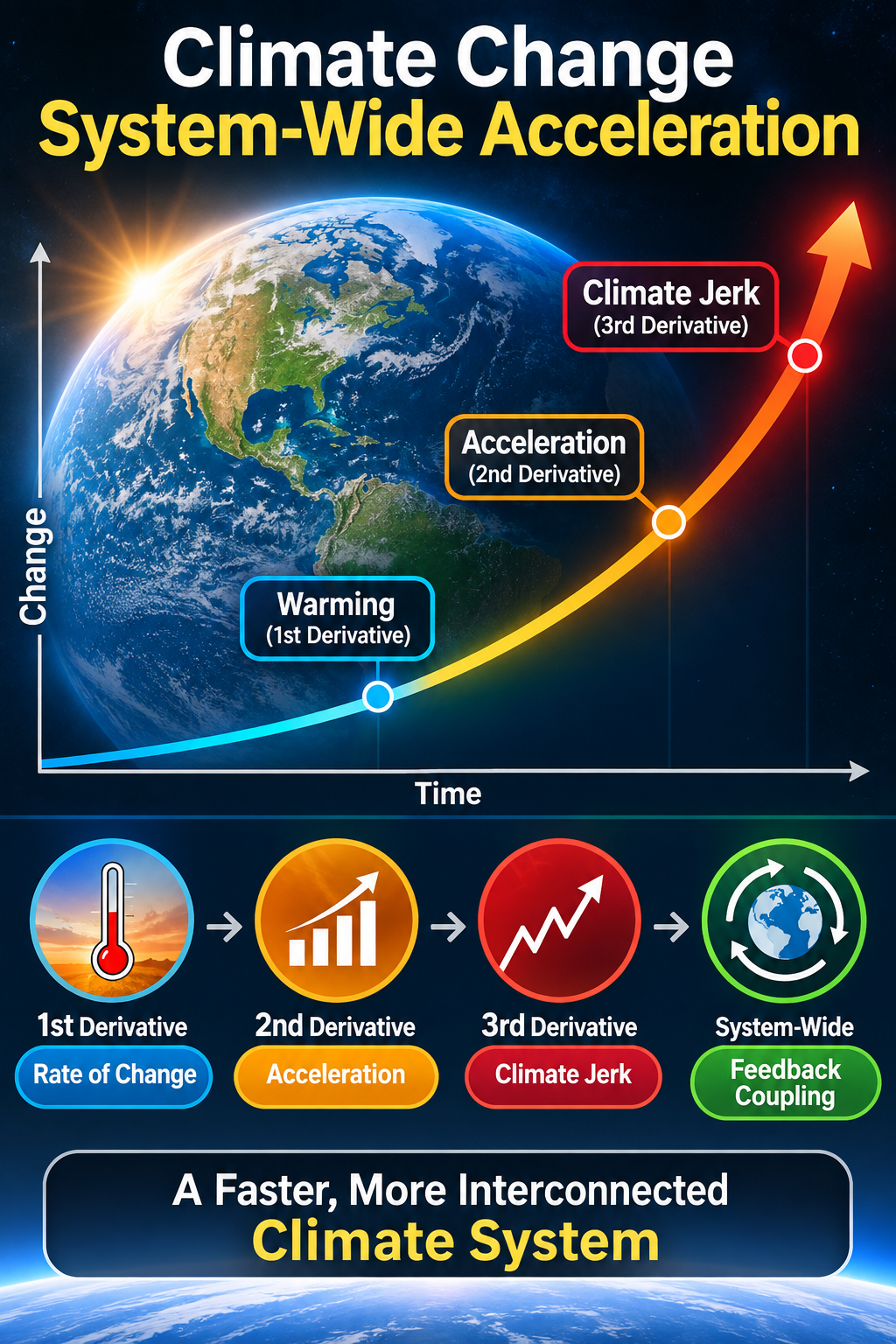
In the paper, “Climate Change Is Accelerating: From Acceleration to Climate Jerk and System-Wide Feedback Coupling,” we examine the progression from ordinary warming to nonlinear acceleration, third-derivative behavior (Climate Jerk), and increasingly interconnected climate feedbacks.
Our research examines several critical developments:
📈 Before the 1990s — 1st Derivative: Measuring the rate of climate change.
📈 1990s — 2nd Derivative: Climate acceleration — measuring how the rate of change increases.
🚨 2020s — 3rd Derivative: Climate Jerk — measuring how acceleration itself changes.
🌎 Today — System-Wide Coupling: Analyzing how multiple climate feedbacks interact, reinforce one another, and amplify changes throughout the Earth system.
Our 2022–2026 analysis identifies a particularly important Albedo–Cloud–Ocean Heat Content feedback triad, accounting for 39.6% of the calculated climate jerk surge weight.
The implications are significant: examining individual climate indicators is no longer enough. We must increasingly measure how the entire climate system is changing, how its feedbacks are interacting, and how rapidly those interactions are evolving.
We are moving from measuring climate change to measuring the changing dynamics of climate change itself.
The question is no longer just how much the planet is warming.
It's how fast the processes driving that warming are changing.
#ClimateChange #ClimateScience #ClimateJerk #ClimateFeedbacks #GlobalWarming #EarthSystemScience #ClimateAcceleration
How Fast Is Climate Change Changing?
The rate at which Earth’s climate is changing is becoming increasingly apparent. More importantly, the rate at which climate change itself is accelerating is becoming easier to observe and measure.
For much of the twentieth century, detecting this acceleration was difficult. Individual climate indicators changed relatively slowly, and the climate system was generally analyzed as a collection of separate variables rather than as an interconnected, dynamically evolving system. Conventional climate projections frequently emphasized approximately linear trends, even as the underlying physics allowed for nonlinear behavior.
By the 1990s, the scientific understanding of climate change was beginning to evolve. Michael E. Mann, Raymond S. Bradley, and Malcolm K. Hughes published their influential hockey-stick reconstruction of historical temperatures, demonstrating the unusual magnitude of modern warming. Meanwhile, the scientific understanding of radiative forcing, developed through more than a century of research, was becoming formalized as a central climate metric in the IPCC’s 1990 First Assessment Report.
The emerging challenge was no longer simply determining whether Earth’s climate was warming. It was determining whether the warming process itself was accelerating.
1. Second-Derivative Behavior: Climate Acceleration
By the late 1990s, changes in individual climate indicators were becoming increasingly apparent. Scientists such as James Hansen were documenting evidence of accelerating global warming, while researchers, including Sidd Mukherjee and Daniel Brouse, were investigating nonlinear behavior in sea-level rise.
Sea-level rise provided an especially useful example because it demonstrated how a relatively gradual physical process could increase its rate of change over time.
Approximate historical global mean sea-level rates illustrate this progression:
| Period | Approximate annual rise |
|---|---|
| Pre-1900 | 0.75 mm/year |
| 1900–2000 | 1.5 mm/year |
These approximate historical values illustrate a doubling of the annual rate over roughly a century. Subsequent observations have documented further acceleration.
This is known as second-derivative behavior, or acceleration.
In mathematical terms:
First derivative (rate of change):
dI/dt
Second derivative (acceleration):
d²I/dt²
Where:
- I represents a climate indicator.
- The first derivative measures its rate of change.
- The second derivative measures the rate at which that rate changes.
When the second derivative is positive, the indicator is accelerating.
Climate change was no longer simply progressing. Its rate of change was increasing, demonstrating nonlinear behavior consistent with exponential growth in certain climate processes.
2. Third-Derivative Behavior: Climate Jerk
By the 2020s, an additional and more consequential pattern was becoming observable: the acceleration of individual climate indicators was itself increasing.
This is known as third-derivative behavior, or jerk.
The mathematical expression for climate jerk is:
J(t) = d³I/dt³
Where:
- J(t) represents climate jerk at time t.
- I represents a climate indicator.
- t represents time.
- The first derivative measures the rate of change.
- The second derivative measures acceleration.
- The third derivative measures the change in acceleration.
A positive third derivative indicates that acceleration is increasing.
Multiple climate indicators have exhibited increasingly pronounced nonlinear behavior, including:
- Flooding and extreme precipitation
- Atmospheric moisture content
- Ocean heat content
- Rossby wave amplification
- Sea-level rise
- Nighttime temperatures and extreme heat
- Ice-sheet mass loss
- Glacial retreat
- Permafrost thaw
- Wildfire activity
- Wet-bulb temperature extremes
These indicators are not independent. They interact through physical processes that redistribute energy, moisture, and heat throughout the Earth system.
Consequently, acceleration in one component can influence the behavior of others, creating interconnected feedback pathways.
The significance of climate jerk is that it provides a mathematical framework for describing a system in which the rate of acceleration is itself increasing.
3. Whole-System Magnitude: From Individual Indicators to Coupled Feedbacks
In 2026, our research, Climate Jerk Surge: Albedo–Cloud–Ocean Heat Content Feedback Triad, examined an important development in climate-system behavior.
The analysis demonstrated that recent changes in climate dynamics are being expressed not simply through continued warming, but through increasing synchronization among multiple radiative and thermal feedback pathways.
A 2022–2026 analysis identified a pronounced increase in calculated coupling jerk across a six-variable climate system.
The strongest contributions were concentrated in a closely interconnected Albedo–Cloud–Ocean Heat Content feedback triad.
The three-way feedback relationship accounted for 39.6% of the displayed surge weight.
This highlights the importance of interactions among Earth’s reflectivity, cloud behavior, and accumulated ocean heat.
This represents a shift in the analytical approach: rather than examining climate indicators exclusively as separate measurements, we are examining how their interactions contribute to the behavior of the entire climate system.
The analysis also highlights the importance of emerging or previously underappreciated feedback pathways, including declining low-level cloud cover and ozone-related atmospheric and ecological forcing.
These processes are particularly important because they can influence the Earth’s energy balance, vegetation productivity, carbon uptake, and the strength of existing feedback mechanisms.
Their increasingly apparent behavior over the relatively short 2022–2026 observation window makes them important subjects for continued investigation.
4. The Transition to Whole-System Measurement
One of the most important developments in climate analysis is the transition from measuring changes in individual indicators to measuring changes in the behavior of the interconnected climate system.
As individual indicators become increasingly nonlinear, distinguishing their underlying acceleration from natural variability, measurement uncertainty, and interacting processes becomes more difficult.
At the same time, the cumulative effects of these processes become increasingly apparent in whole-system measurements.
Earth’s energy imbalance is particularly important.
More than 90% of the excess energy accumulating in the climate system is entering the oceans. Ocean heat content therefore provides a powerful measure of the cumulative consequences of the Earth’s energy imbalance.
The advantage of whole-system analysis is that it captures the combined effects of multiple interacting processes rather than relying exclusively on the behavior of individual indicators.
This is especially important when feedbacks become coupled and changes in one component amplify changes in another.
The result is a climate system whose behavior cannot be adequately described by examining individual trends in isolation.
5. The Bigger Picture: Measuring How Quickly Climate Change Is Changing
The progression from first-derivative warming to second-derivative acceleration and third-derivative jerk represents an increasingly sophisticated understanding of climate-system behavior.
First derivative — Rate of change
dI/dt
The climate is warming, and individual indicators are changing.
Second derivative — Acceleration
d²I/dt²
The rate of climate change is increasing.
Third derivative — Climate jerk
J(t) = d³I/dt³
The acceleration of climate change is increasing.
Fourth consideration — System-wide feedback coupling
Multiple climate processes increasingly interact, synchronize, and amplify changes throughout the Earth system.
The central issue is no longer simply how much Earth’s temperature has increased, or even how quickly it is increasing.
It is how quickly the processes driving climate change are themselves changing.
This distinction matters because a climate system experiencing increasing acceleration and increasingly interconnected feedbacks behaves differently from one following a relatively stable, linear trajectory.
We are moving from measuring climate change to measuring the changing dynamics of climate change itself.
That is the significance of climate jerk and whole-system feedback coupling—Climate Change System-Wide Acceleration.
The Climate Tipping Point Crisis Is Here
Resources and Sources
Climate Change Threshold Dynamics and Singularity
Feedback Loops → Tipping Points → Feedback Loop and Tipping-Point Network → Acceleration → Domino Effect
Feedback loops amplify climate change and can push interconnected Earth systems past critical tipping points. As tipping points are crossed, they can trigger additional feedback loops and destabilize other climate systems. This cascading "Domino Effect" compresses timescales, accelerates change, and increases the risk of rapid, nonlinear climate transformations.
Current Status: Climate Tipping Point Crisis
Easy-to-Read Resources