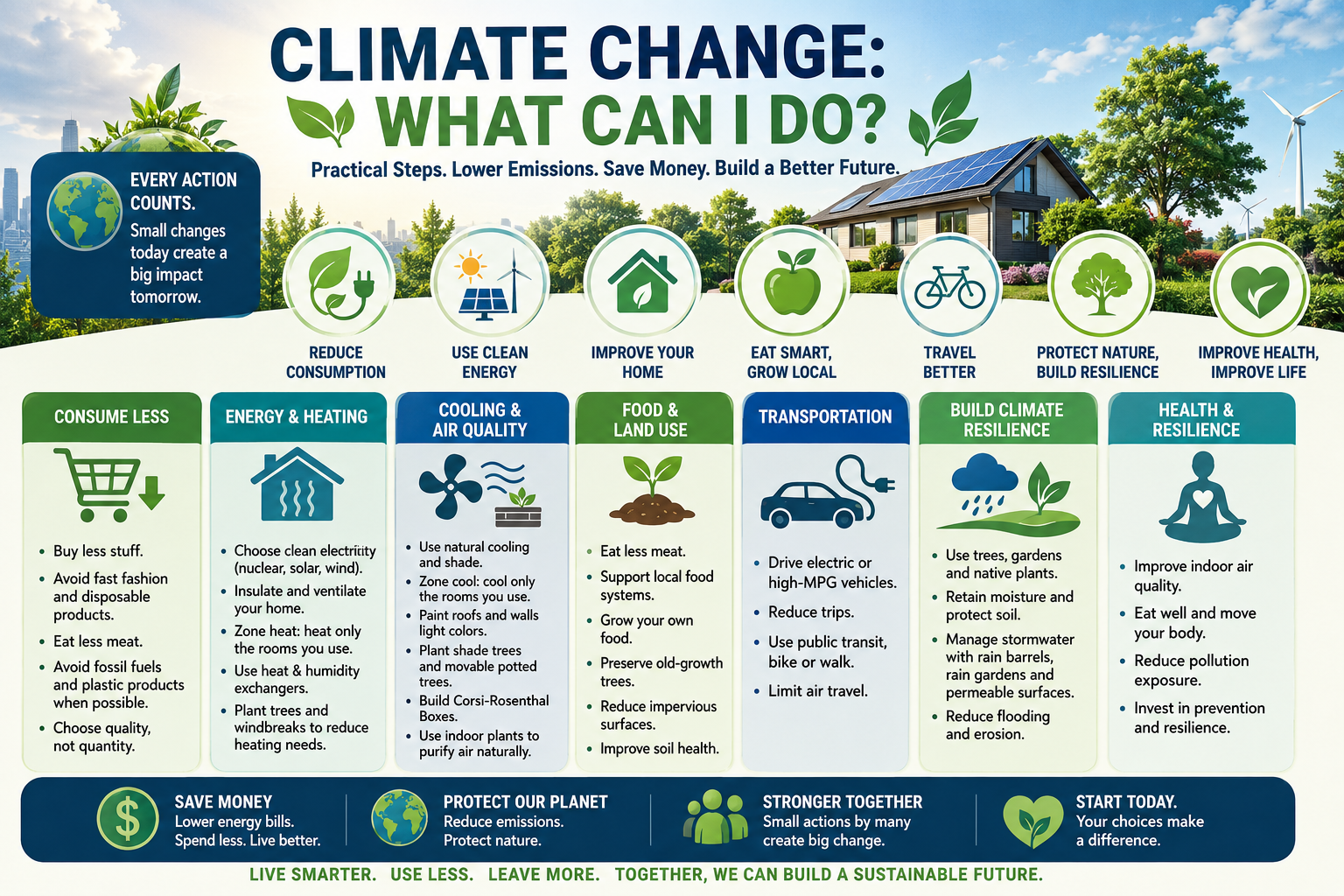
Climate Change: What Can I Do?
1Independent Climatologist, Economist, Membrane Domain, USA
2Independent Physicist, Membrane Domain, USA
Reaching Net Zero: Practical Steps That Save Money
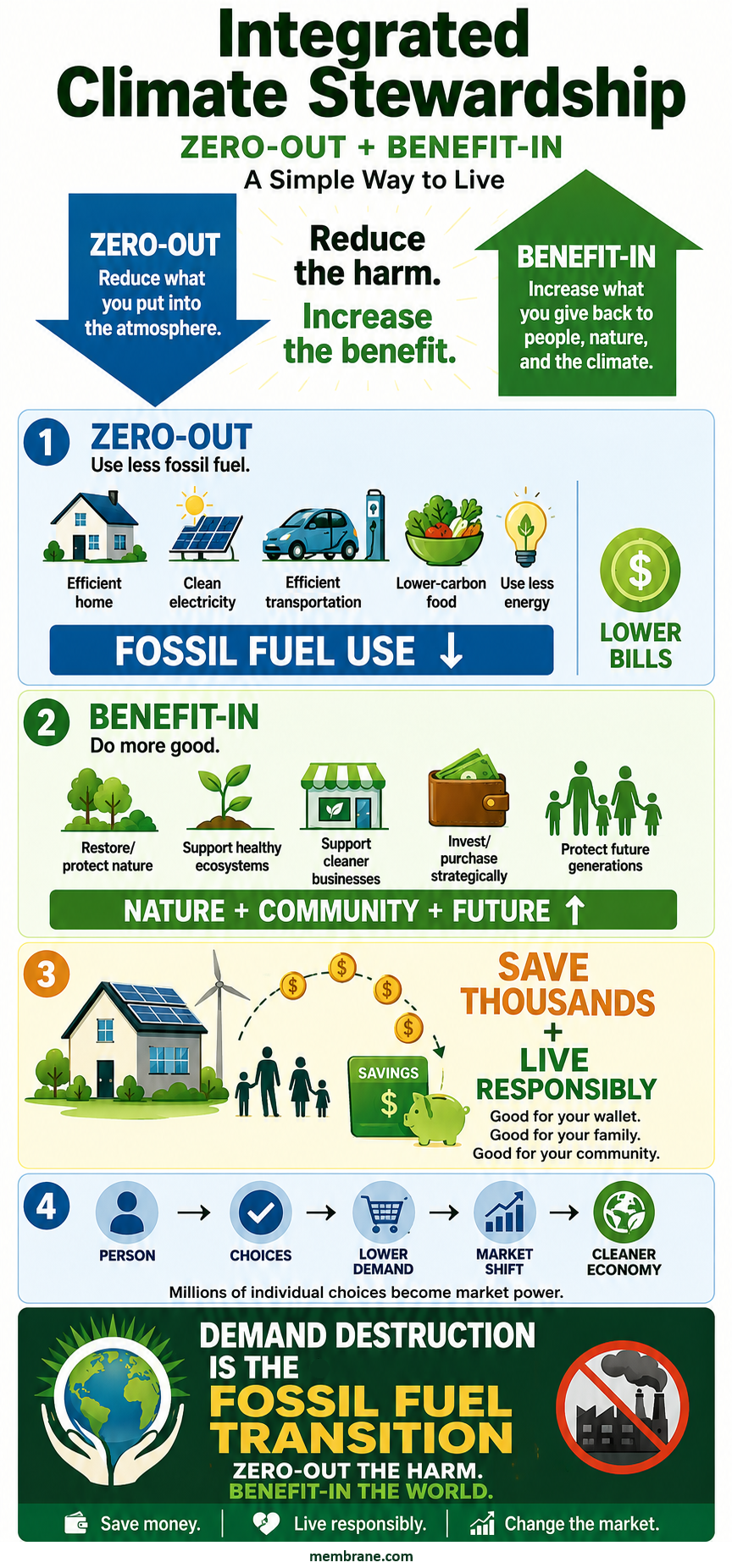
I’ve already gone “net zero”—or, perhaps more accurately, adopted Integrated Climate Stewardship—and in the process, I’ve saved and earned thousands of dollars. Reducing your climate impact isn’t just possible; it can improve quality of life, increase resilience, and lower long-term costs.
What is Integrated Climate Stewardship?
As both a climatologist and an economist, I’m less concerned with setting a specific date for eliminating fossil fuels than with changing the economic forces that sustain fossil-fuel demand. I’m unlikely to change the minds of the roughly 20% of Americans who are ideologically committed to policies that accelerate climate change. But that leaves roughly 80%—and economics can do much of the work.
Integrated Climate Stewardship begins with reducing unnecessary consumption. Consumerism drives energy demand, resource extraction, pollution, and habitat destruction. The less we consume, the less pressure we place on the climate and the ecosystems that sustain us.
Today, perhaps only ~0.5% of Americans are seriously pursuing a structured net-zero lifestyle through continuous behavioral reductions and intentional balancing. But when people discover that reducing their climate impact can save them thousands of dollars a year while leaving a healthier environment for their children and grandchildren, behavior can change.
When the remaining ~79.5% begin voting with their dollars, fossil-fuel demand falls. That demand destruction reduces the economic incentive to produce fossil fuels.
Demand destruction is the transition away from fossil fuels.
And to be clear, I’m not using “net zero” to justify continued emissions based on the assumption that unproven technologies or questionable offsets will clean them up later. I mean reducing—and wherever realistically possible, eliminating—the emissions associated with my own lifestyle while taking responsibility for impacts I cannot immediately eliminate.
That’s why I’m moving away from “net zero” toward Integrated Climate Stewardship: a more holistic approach focused on reducing consumption, increasing resilience, and taking responsibility for our real-world impacts.
See Money Moves People: Why Demand Destruction May Be the Fastest Path Beyond Fossil Fuels
How I Integrated Climate Stewardship
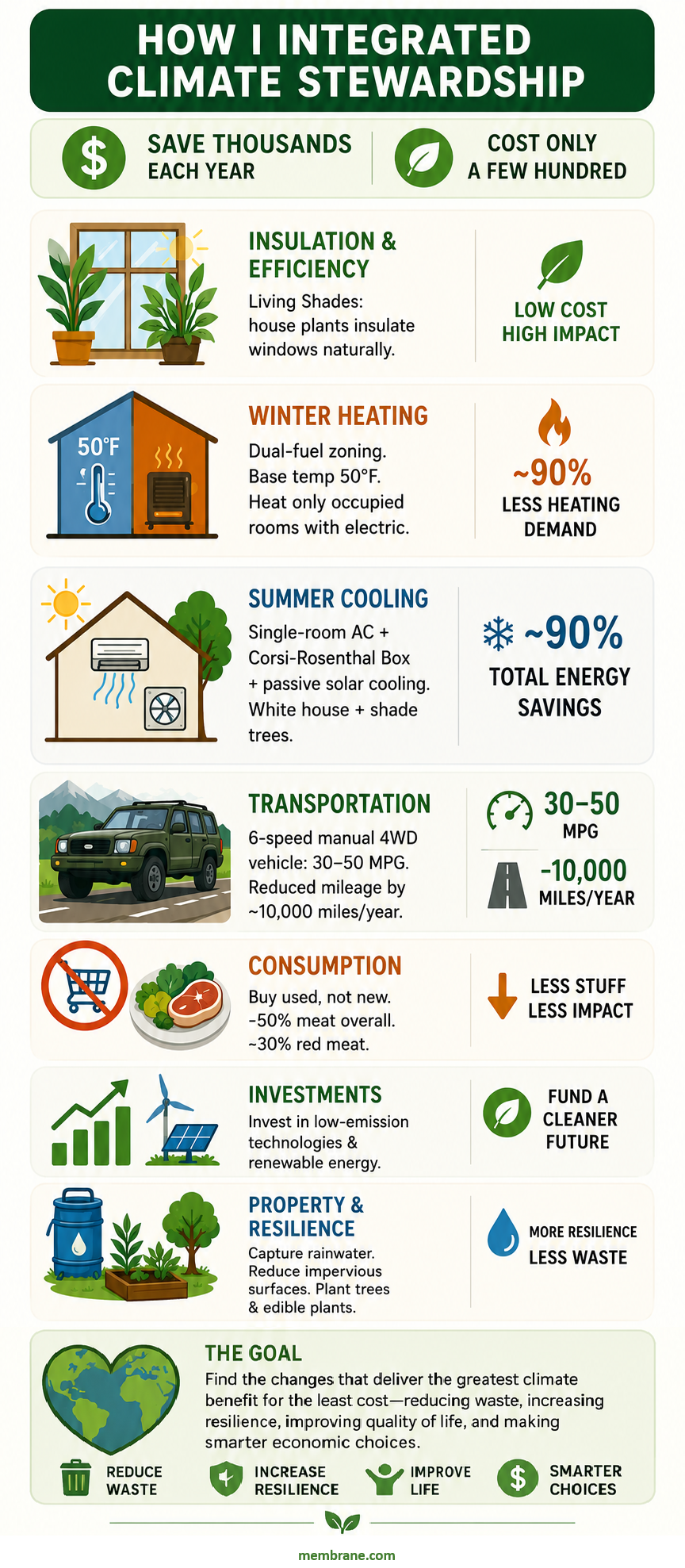
How you achieve Integrated Climate Stewardship will depend on your lifestyle, resources, location, and—most importantly—the climate you are experiencing. What worked for me may not work for you, but my experience can serve as an example. I now save thousands of dollars annually through changes that cost only a few hundred dollars to implement.
I started with insulation and energy efficiency. That doesn’t necessarily mean replacing doors and windows or spending thousands of dollars. In my situation, the most cost-effective strategy was developing Living Shades: House Plants as Nature’s Window Insulation. Other simple, low-cost changes included installing an electric instant hot water heater and drying clothes outside on a line whenever weather permits.
Next, I reduced winter heating demand by about 90% through dual-fuel zoning. My house operates on oil, so I set the base temperature at 50°F and use efficient electric heaters only in the rooms being occupied. Because I happen to live between three nuclear power plants, this strategy works particularly well for me. Investigate how your electricity is generated and whether cleaner alternatives are available in your area.
I applied the same principle to summer cooling. Rather than running central air throughout the house, I use a single-room AC unit, a Corsi-Rosenthal Box on each floor, and supplemental Passive Solar-Driven Heat Rejection Using Phase-Change Energy Transfer. Together, these measures reduced my cooling energy use by about 70%. Painting the house white and surrounding it with large shade trees produced another 20% savings.
Transportation presented a different challenge. My circumstances require occasional long-distance driving and a four-wheel-drive vehicle. One of my most effective carbon-reduction choices was switching to a six-speed manual transmission vehicle capable of 30–50 MPG. I also reduced my annual mileage by about 10,000 miles.
On the consumption side, I have virtually eliminated purchases of anything “new” whenever a used or existing alternative will do. I’ve reduced my overall meat consumption by about 50%, including an additional reduction of roughly 30% in red meat.
I also redirected my investments and retirement savings toward lower-emission technologies and utility companies focused on renewable energy. And I made dozens of smaller changes: reducing impervious surfaces, capturing and reusing rainwater, planting edible plants, and finding ways to make the property itself more productive and resilient.
The point isn’t to copy my lifestyle. It’s to look at your own circumstances and identify the changes that produce the greatest climate benefit for the least cost. Integrated Climate Stewardship is not about sacrifice for sacrifice’s sake. It is about reducing waste, increasing resilience, improving quality of life, and making smarter economic choices.
There are many more ideas and strategies below.
The Economic Transition
The larger goal is to move beyond individual action and change the economic system through millions of individual decisions. When people discover that lower consumption can also mean lower expenses, greater resilience, and a better quality of life, climate action becomes economically attractive rather than simply an obligation.
As more people make those choices, demand for fossil fuels declines. Lower demand eventually reduces the incentive to extract, refine, transport, and sell them. This is why I believe demand destruction may be one of the most powerful mechanisms of the fossil-fuel transition.
Rather than depending entirely on political mandates to force consumers and producers away from fossil fuels, Integrated Climate Stewardship seeks to make lower-emission choices increasingly attractive on their own economic merits.
Why AI Changes the Equation
I’m also developing the economic model behind this approach. That’s the more complicated part—not because of the terminology, but because AI is changing the underlying economics so rapidly.
AI has the potential to fundamentally alter the relationship between productivity, labor, energy, materials, land, and consumption. That means the economic model that best supports climate stewardship may not be a traditional model of either perpetual growth or simple degrowth.
The challenge is to understand what an increasingly AI-driven economy means for resource use, productivity, consumption, and ultimately climate impact.
That is the next part of the conversation.
For the full story, see: Integrated Climate Stewardship: Demand Destruction Is the Fossil Fuel Transition
Integrated Climate Stewardship
Consume Less
- Reduce unnecessary purchases.
- Avoid fast fashion and disposable products.
- Reduce travel when practical.
- Consume less meat and other resource-intensive products.
- Minimize the use of fossil fuels and hydrocarbon-based products whenever possible.
- Buy durable, repairable products instead of replacing them frequently.
Energy and Heating
- Choose electricity providers that utilize nuclear, solar, wind, or other low-carbon energy sources.
- Insulate your home while maintaining proper ventilation.
- Practice zone heating: keep the overall house cooler and heat only occupied rooms as needed.
- Use heat-recovery and humidity-exchange ventilation systems.
- Plant trees, shrubs, and windbreaks to reduce winter heating demand.
- Use potted trees and seasonal landscaping to help insulate foundations and reduce energy loss.
Energy, Cooling, and Air Quality
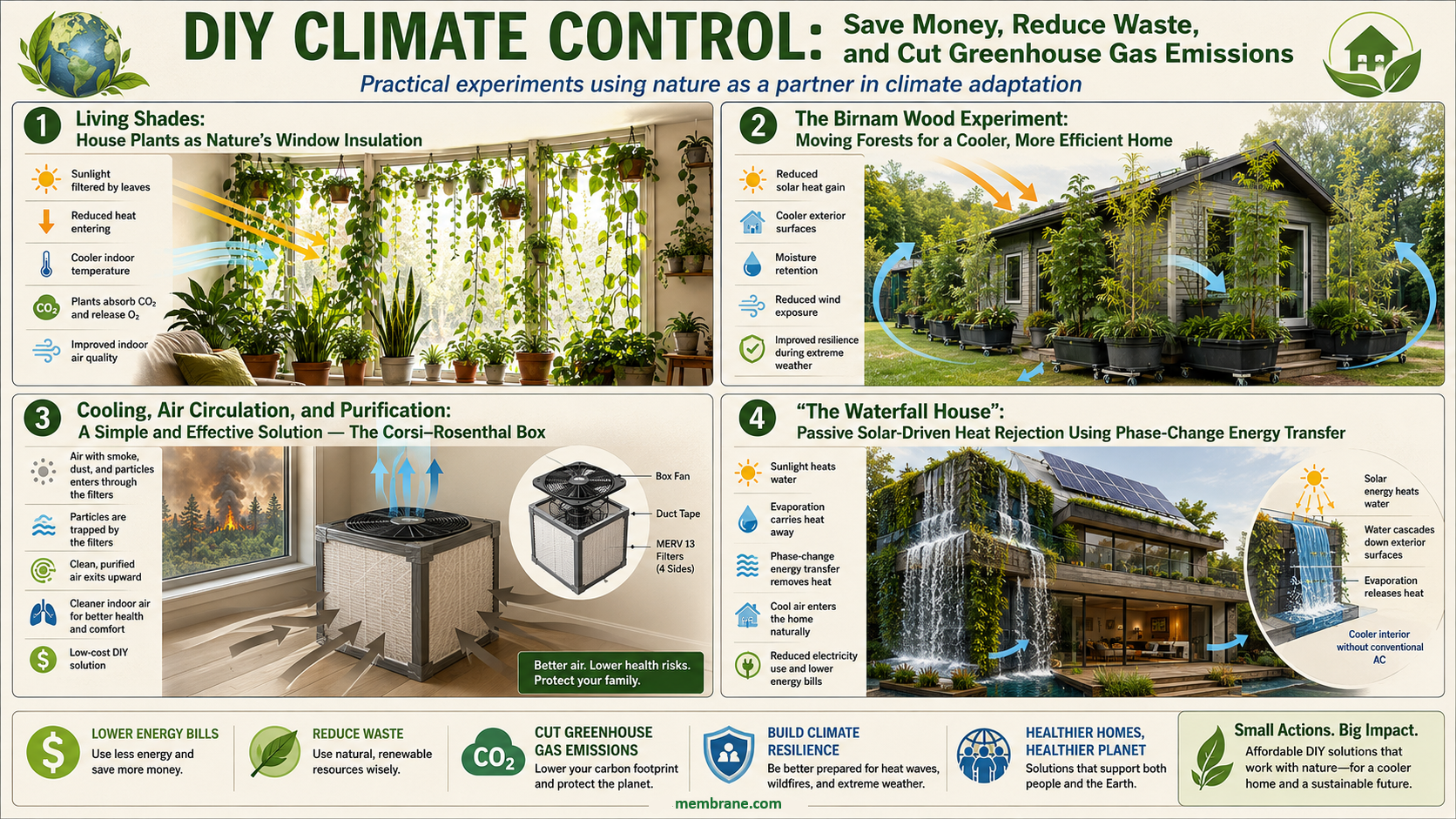
- Use natural cooling strategies whenever possible.
- Use evaporative roof cooling to harness passive solar-driven heat rejection through phase-change energy transfer.
- Improve your home’s energy efficiency with easy to create living shades.
- Create climate resilience by using moveable trees and vegetation.
- Practice zone cooling by cooling only occupied spaces.
- Maintain indoor temperatures efficiently rather than overcooling entire buildings.
- Paint roofs and exterior surfaces white or lighter colors where appropriate to reduce heat absorption.
- Plant shade trees to block direct sunlight and lower cooling demand.
- Create a movable canopy using potted trees that can be repositioned seasonally.
- Build Corsi-Rosenthal Boxes for each floor to filter and circulate air effectively without energy-intensive systems.
- Use indoor plants and natural ventilation to improve air quality.
Food and Land Use
- Support local and regional food systems.
- Grow some of your own food when possible.
- Preserve mature and old-growth trees.
- Reduce impervious surfaces that increase runoff and heat retention.
- Improve soil health through composting and regenerative practices.
Transportation
- Use electric vehicles or high-efficiency vehicles when practical.
- Reduce unnecessary trips.
- Use public transportation, cycling, or walking when possible.
- Limit air travel and choose lower-carbon alternatives when feasible.
Climate Resilience Around the Home
- Create a climate-resilient environment around your home using trees, gardens, and soil protection to retain moisture, block wind, and prevent degradation.
- Retain moisture naturally through vegetation and soil protection.
- Reduce erosion and flooding with rain gardens, rain barrels, trees, and permeable surfaces.
- Improve stormwater management with rain barrels, rain gardens, trees, and permeable surfaces to reduce flooding and erosion during extreme weather.
Health and Resilience
- Improve indoor air quality and reduce indoor pollution.
- Optimize your health and diet to build resilience and reduce healthcare-related environmental impacts.
- Reduce pollution exposure whenever possible.
- Invest in prevention rather than treatment whenever practical.
DIY Climate Control
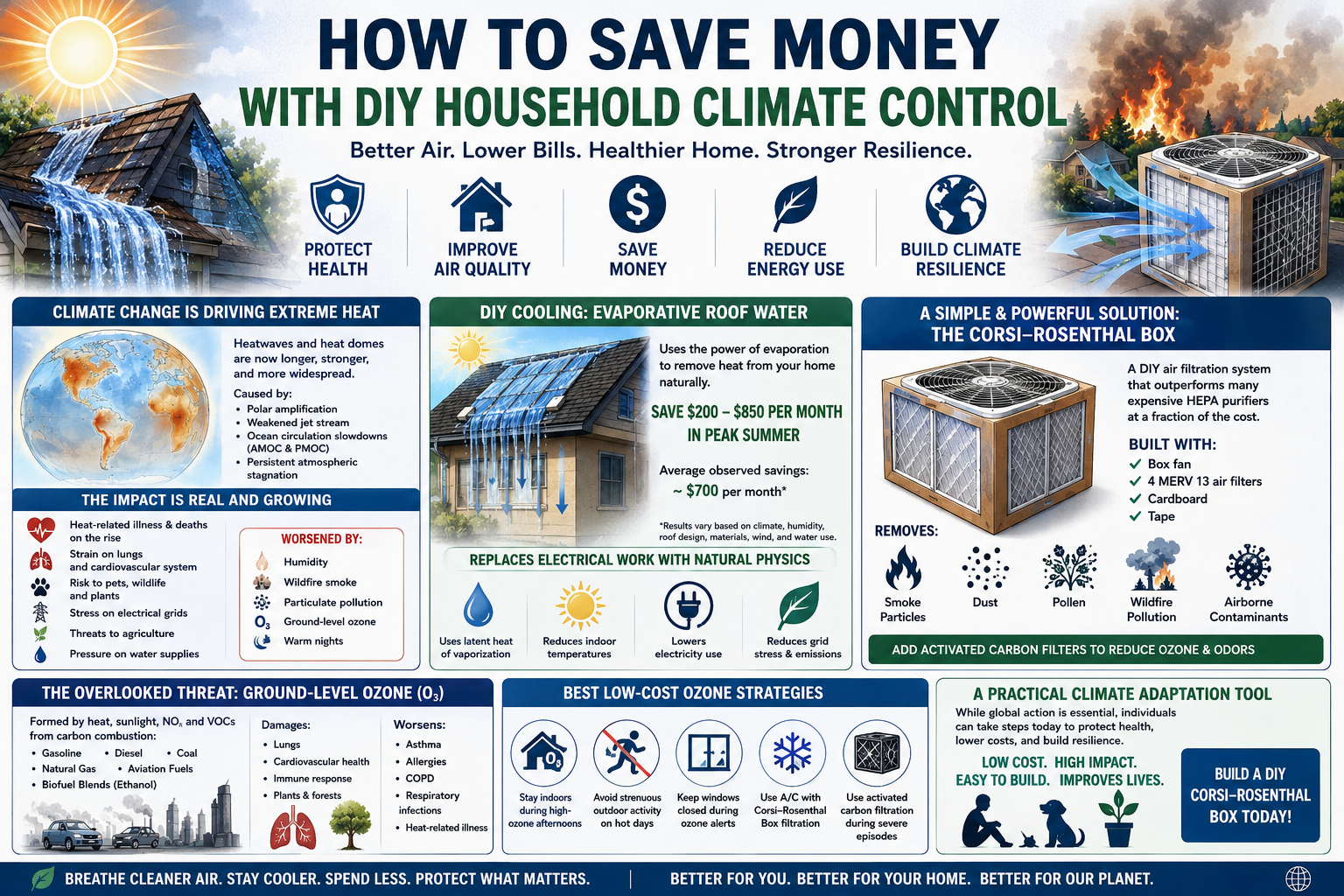
Heat waves are starting earlier, becoming more intense, and lasting longer as climate change reshapes weather patterns around the world. In the United States, extreme heat events have become significantly more likely due to human-caused warming. The same trend is affecting the UK and Europe, where aging infrastructure, rising energy demand, and political debates over air conditioning are colliding with the growing reality of a hotter climate.
Preparing for extreme heat does not always require expensive upgrades or major renovations. Simple, low-cost DIY climate control solutions can help keep homes cooler, improve indoor air quality, reduce energy consumption, and increase resilience during heat waves and power disruptions.
Extreme heat is more than an inconvenience—it is a serious health risk. Elevated temperatures place stress on the cardiovascular and immune systems and can affect cellular processes when exposure becomes severe or prolonged. Emerging research suggests that the temperature thresholds for some heat-related biological impacts may be lower than previously understood. A Corsi–Rosenthal Box can improve indoor conditions by increasing air circulation, reducing airborne particulate pollution, and helping maintain more stable indoor environments.
As climate change drives increased reliance on air conditioning, indoor air quality can decline due to reduced ventilation and the accumulation of indoor pollutants. Energy efficiency is therefore a critical component of climate adaptation. A Corsi–Rosenthal Box used alongside air conditioning can allow cooling systems to operate more efficiently by improving air mixing and filtration, reducing energy demand while maintaining comfort and healthier indoor air.
Additional passive cooling strategies, such as passive solar-driven heat rejection using phase-change energy transfer, offer affordable ways to reduce indoor temperatures without increasing electricity consumption. These approaches can provide meaningful savings—potentially hundreds to thousands of dollars per year—while improving household resilience in an era of increasingly extreme heat.
The good news is that many of these actions save money rather than cost money. In many cases, the most climate-friendly choices are also the most economically efficient. The first step is often the simplest: consume less, waste less, and use energy more wisely.
That's actually a very good closing paragraph because it brings the entire article back to your central thesis:
Climate stewardship → less consumption → lower costs → greater resilience → demand destruction.
Note
* Our probabilistic, ensemble-based climate model — which incorporates complex socio-economic and ecological feedback loops within a dynamic, nonlinear system — projects that global temperatures are becoming unsustainable this century. This far exceeds earlier estimates of a 4°C rise over the next thousand years, highlighting a dramatic acceleration in global warming. We are now entering a phase of compound, cascading collapse, where climate, ecological, and societal systems destabilize through interlinked, self-reinforcing feedback loops.
We examine how human activities — such as deforestation, fossil fuel combustion, mass consumption, industrial agriculture, and land development — interact with ecological processes like thermal energy redistribution, carbon cycling, hydrological flow, biodiversity loss, and the spread of disease vectors. These interactions do not follow linear cause-and-effect patterns. Instead, they form complex, self-reinforcing feedback loops that can trigger rapid, system-wide transformations — often abruptly and without warning. Grasping these dynamics is crucial for accurately assessing global risks and developing effective strategies for long-term survival.
Feedback Loops →
Tipping Points →
Acceleration →
Domino Effect
Feedback loops amplify climate change and can push interconnected Earth systems past critical tipping points. As tipping points are crossed, they can trigger additional feedback loops and destabilize other climate systems. This cascading "Domino Effect" compresses timescales, accelerates change, and increases the risk of rapid, nonlinear climate transformations.