by Daniel Brouse -- July 26, 2025
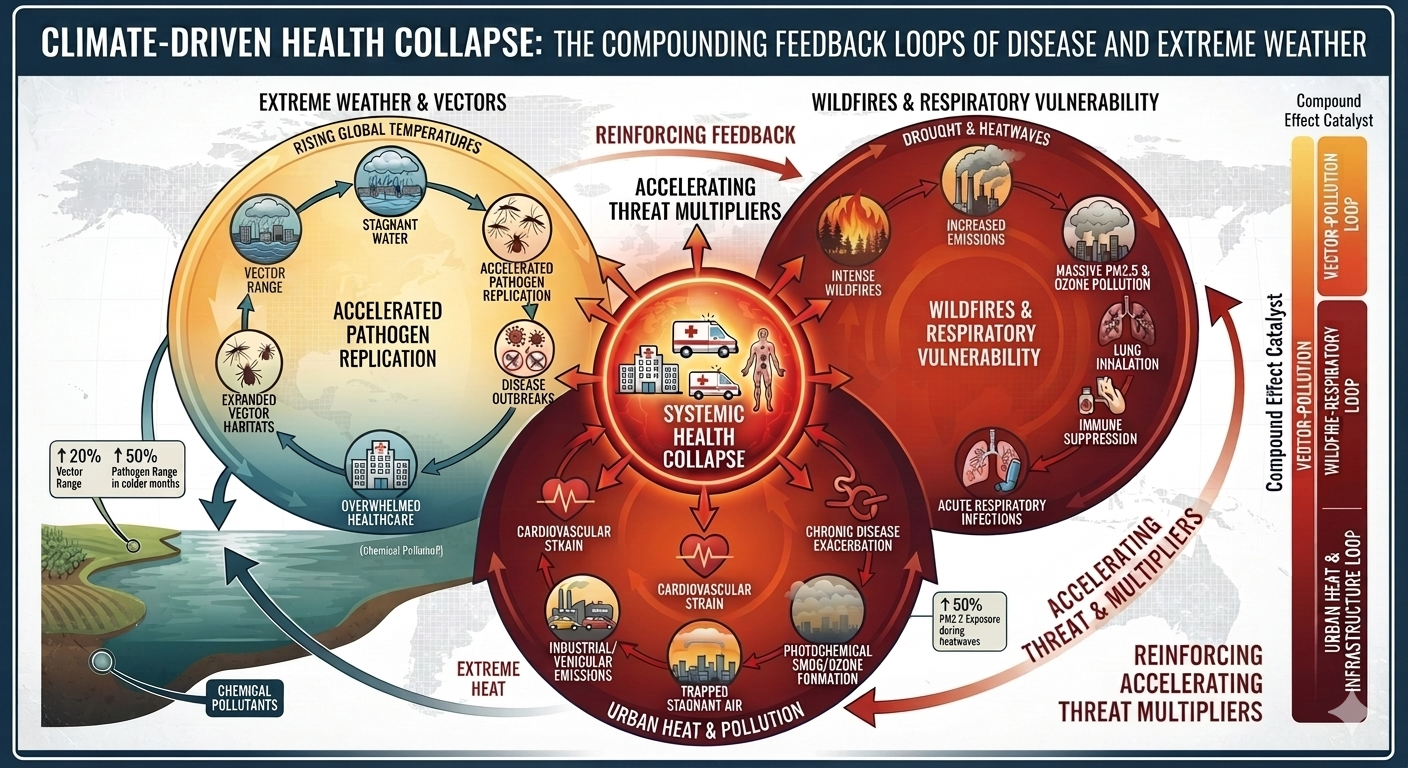
Climate change is not just an environmental issue -- it is a cascading health crisis. As rising global temperatures disrupt natural systems, they initiate multiple interconnected health feedback loops that reinforce and amplify one another. These loops do not operate in isolation, nor do they follow a predictable or linear trajectory. Instead, the breakdown of one subsystem accelerates the collapse of others, resulting in nonlinear, compounding effects that degrade both the quality and quantity of human life.
There are at least three major categories of climate-related health stressors that interact and reinforce each other:
Zoonotic diseases such as COVID-19, Ebola, and avian influenza are spreading more rapidly due to deforestation, warming temperatures, and habitat loss -- conditions that increase human-animal contact and vector range.
Climate-sensitive vectors (like mosquitoes) expand into new regions, introducing dengue, malaria, and Zika to previously unaffected populations.
Ground-level ozone, particulate matter (PM2.5), and wildfire smoke directly damage lungs and weaken immune response.
Air pollution is responsible for millions of premature deaths annually and is a major co-factor in cardiovascular disease, chronic obstructive pulmonary disease (COPD), asthma, and cancer.
Pollution exposure also increases the risk of infection, as seen with COVID-19 morbidity patterns.
One death per minute: The surge in heat-related deaths now equates to roughly one fatality every minute worldwide.
Rising exposure: The average person has endured 19 days per year of life-threatening heat over the past four years -- nearly all attributed to human-caused warming.
Severe health impacts: Extreme heat leads to heatstroke, dehydration, kidney injury, and worsens existing heart and lung diseases.
Prolonged exposure to extreme heat accelerates biological aging, damaging tissues and shortening telomeres at a cellular level.
These changes increase the likelihood of chronic diseases such as cancer, dementia, and diabetes -- all of which are also made worse by pollution and infection.
Heat stress also undermines mental health and increases rates of depression, anxiety, and even suicide.
A critical link between these health risks is the role of epigenetic changes -- chemical modifications that influence how genes are expressed without altering the DNA sequence itself. These changes act like a dimmer switch or on/off toggle for genes, activating or silencing certain genetic pathways.
Extreme heat, ozone exposure, and COVID-19 infection are all known to trigger epigenetic modifications.
These shifts can activate high-risk genes linked to cancer, diabetes, cardiovascular conditions, and neurological disorders.
When multiple stressors are present, these epigenetic changes do not just add up -- they compound, increasing long-term vulnerability across multiple organ systems.
This molecular-level disruption represents a shared mechanism across climate-related health threats, amplifying the feedback loops that push individuals toward chronic illness and premature death. It also raises concerns about transgenerational impacts, where stress-induced epigenetic changes in one generation may increase disease risk in the next.
Consider how air pollution and COVID-19 create a self-reinforcing health spiral:
Long-term air pollution exposure causes underlying conditions (respiratory disease, cardiovascular disease, immune suppression).
Infection with COVID-19 worsens these existing conditions, leading to more severe illness and higher mortality risk.
Post-infection, continued pollution exposure leads to long COVID complications and recurring hospitalizations.
The repeated cycle exhausts the body's defenses -- a negative feedback loop that continues until systemic collapse or death.
This is not a hypothetical. It is happening now.
When these health stressors converge, they don't just affect individuals -- they strain public health systems, increase medical costs, and undermine economic productivity. The reinforcing nature of these loops means we are hurtling toward tipping points in healthcare infrastructure, workforce resilience, and population longevity.
The climate crisis is also a health crisis. The compounding effects of infectious disease, environmental pollution, and extreme heat form a web of destabilization that shortens lives and overwhelms systems. Without rapid action to reduce greenhouse gas emissions, regulate pollutants, and build climate-resilient healthcare systems, these feedback loops will escalate beyond control.
Tropospheric Ozone: A Silent Threat to Health and the Environment
* Our probabilistic, ensemble-based climate model — which incorporates complex socio-economic and ecological feedback loops within a dynamic, nonlinear system — projects that global temperatures are becoming unsustainable this century. This far exceeds earlier estimates of a 4°C rise over the next thousand years, highlighting a dramatic acceleration in global warming. We are now entering a phase of compound, cascading collapse, where climate, ecological, and societal systems destabilize through interlinked, self-reinforcing feedback loops.
We examine how human activities — such as deforestation, fossil fuel combustion, mass consumption, industrial agriculture, and land development — interact with ecological processes like thermal energy redistribution, carbon cycling, hydrological flow, biodiversity loss, and the spread of disease vectors. These interactions do not follow linear cause-and-effect patterns. Instead, they form complex, self-reinforcing feedback loops that can trigger rapid, system-wide transformations — often abruptly and without warning. Grasping these dynamics is crucial for accurately assessing global risks and developing effective strategies for long-term survival.
The Climate Crisis: Violent Rain | Deadly Humid Heat | Health Collapse | Extreme Weather Events | Insurance | Trees and Deforestation | Soil | Rising Sea Level | Food and Water