by Daniel Brouse - 2026
Heat Stress, Human Survivability, and the Emerging Physiological Limits of Climate Change
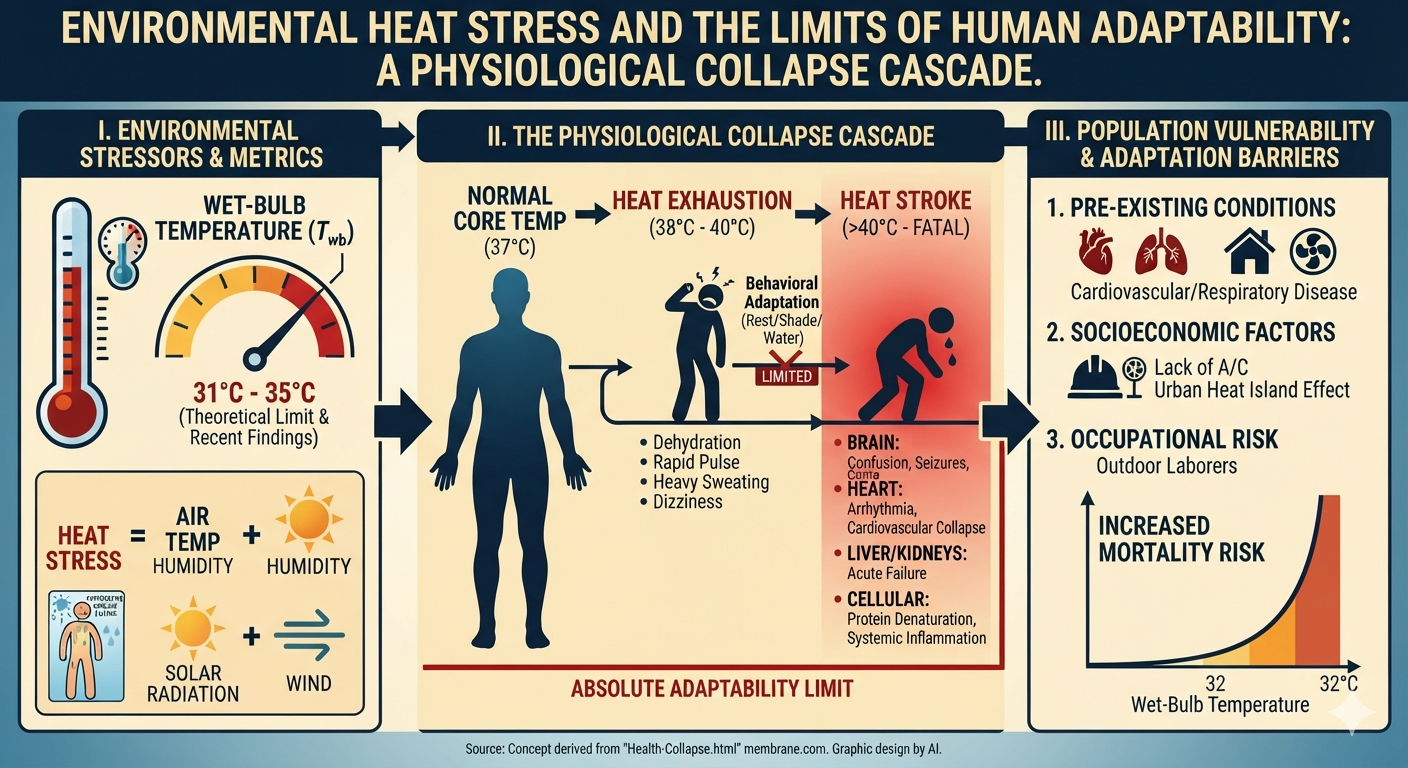
For decades, many researchers assumed humans could generally survive “wet-bulb” temperatures near 35°C (95°F at 100% humidity) for limited periods. This threshold was widely treated as the upper survivability boundary for healthy individuals under shaded and ventilated conditions.Many newer experiments now indicate that:
- 31°C wet-bulb (~87.8°F) may already be dangerous or unsurvivable for many healthy adults after prolonged exposure.
- For elderly individuals or vulnerable populations, critical stress may begin closer to: 28–30°C wet-bulb (~82–86°F).
Modern humans (Homo sapiens) are approximately 200,000 years old, with some of our closest ancestral lineages dating back roughly 140,000 years. One of the oldest known oral traditions may provide a remarkable example of humanity’s long environmental memory: the story of the Seven Sisters of the Pleiades.
The Pleiades are a cluster of stars in the Taurus constellation. Today, six stars are easily visible to the naked eye, yet many ancient traditions across the world describe seven visible sisters. Some researchers suggest these stories may preserve observations from many tens of thousands of years ago, before stellar movement made the seventh star difficult to see without magnification.
Among the oldest continuous cultural traditions associated with the Pleiades are the Dreaming stories of Aboriginal Australians. These interconnected “songlines” span much of the Australian continent, linking ecological knowledge, astronomy, navigation, and seasonal cycles across dozens of language groups and cultures.
First Nations Australians are also among the earliest groups to recognize localized ecological disruptions associated with anthropogenic climate change. Their approximately 65,000 years of continuous connection to Country produced highly localized ecological calendars based not on fixed months, but on relationships among plants, animals, weather patterns, and stars. This deep environmental literacy enabled them to track subtle shifts in ecosystems long before modern climate science emerged.
Yet even populations with millennia of environmental adaptation have limits.
Although Aboriginal Australians survived in some of the harshest climates on Earth, they have not escaped the physiological and societal burdens associated with environmental stress. Today, Indigenous Australians continue to experience significantly lower life expectancy compared to non-Indigenous populations, reflecting the complex interaction of environmental, social, economic, and health stressors.
Long-term adaptation over thousands of years is fundamentally different from rapid climate destabilization unfolding over mere decades.
The dangers of rising temperatures extend far beyond mass casualty events during heatwaves.
Heat exposure increasingly functions as a chronic, whole-body stressor capable of degrading human health over time.
Recent analyses estimate that the average person now experiences roughly 19 days per year of potentially life-threatening heat exposure, with most of that increase attributable to human-caused climate warming.
The impacts extend well beyond heatstroke.
Prolonged exposure to elevated temperatures contributes to:
Emerging research also indicates that chronic heat exposure can accelerate biological aging by damaging tissues, impairing mitochondrial function, and shortening telomeres at the cellular level.
These processes are associated with elevated risks of:
Heat stress also significantly affects mental health, increasing rates of:
The cumulative burden of these stressors becomes even more dangerous when combined with pollution exposure, infectious disease, nutritional instability, and economic stress.
Arguments that humans have “always adapted” to heat fundamentally misunderstand the timescale problem.
Human adaptation historically occurred across evolutionary and cultural timescales spanning thousands of years.
Modern climate destabilization is unfolding within decades.
The challenge is not simply rising temperature — it is the accelerating interaction of multiple environmental stressors occurring simultaneously within highly interconnected systems.
One of the most important emerging areas of research involves epigenetics — chemical modifications that influence how genes are expressed without changing the underlying DNA sequence itself.
These mechanisms function somewhat like biological dimmer switches, activating or suppressing genetic pathways in response to environmental conditions.
Extreme heat, particularly when combined with:
is increasingly associated with epigenetic modification.
Research suggests these changes may influence genes linked to:
Critically, when multiple environmental stressors occur simultaneously, their effects may not simply add together — they may compound through interacting biological feedback loops.
This molecular-level disruption may represent a shared underlying mechanism connecting many climate-related health threats.
The implications are profound.
Climate change may not only reduce lifespan through direct heat mortality, but also through the gradual amplification of chronic disease, immune dysfunction, cognitive decline, and systemic physiological stress across entire populations.
Researchers are also increasingly concerned about potential transgenerational effects, where environmentally induced epigenetic changes in one generation may influence disease susceptibility in the next.
Climate change is not simply an environmental crisis.
It is increasingly a physiological, neurological, immunological, and societal stress crisis operating across multiple interconnected systems simultaneously.
The question is no longer whether humans can survive occasional extreme heat events.
How well can human biology, infrastructure, healthcare systems, economies, and societies adapt to accelerating, compounding environmental stressors occurring at historically unprecedented rates?
Current evidence suggests the limits may be approaching far sooner than previously assumed.
* Our probabilistic, ensemble-based climate model — which incorporates complex socio-economic and ecological feedback loops within a dynamic, nonlinear system — projects that global temperatures are becoming unsustainable this century. This far exceeds earlier estimates of a 4°C rise over the next thousand years, highlighting a dramatic acceleration in global warming. We are now entering a phase of compound, cascading collapse, where climate, ecological, and societal systems destabilize through interlinked, self-reinforcing feedback loops.
We examine how human activities — such as deforestation, fossil fuel combustion, mass consumption, industrial agriculture, and land development — interact with ecological processes like thermal energy redistribution, carbon cycling, hydrological flow, biodiversity loss, and the spread of disease vectors. These interactions do not follow linear cause-and-effect patterns. Instead, they form complex, self-reinforcing feedback loops that can trigger rapid, system-wide transformations — often abruptly and without warning. Grasping these dynamics is crucial for accurately assessing global risks and developing effective strategies for long-term survival.