Lightning-Generated Tropospheric Ozone and Earth-System Feedbacks
Daniel Brouse¹ and Sidd Mukherjee²
June 2026
¹Independent Climate Researcher, Economist
²Physicist
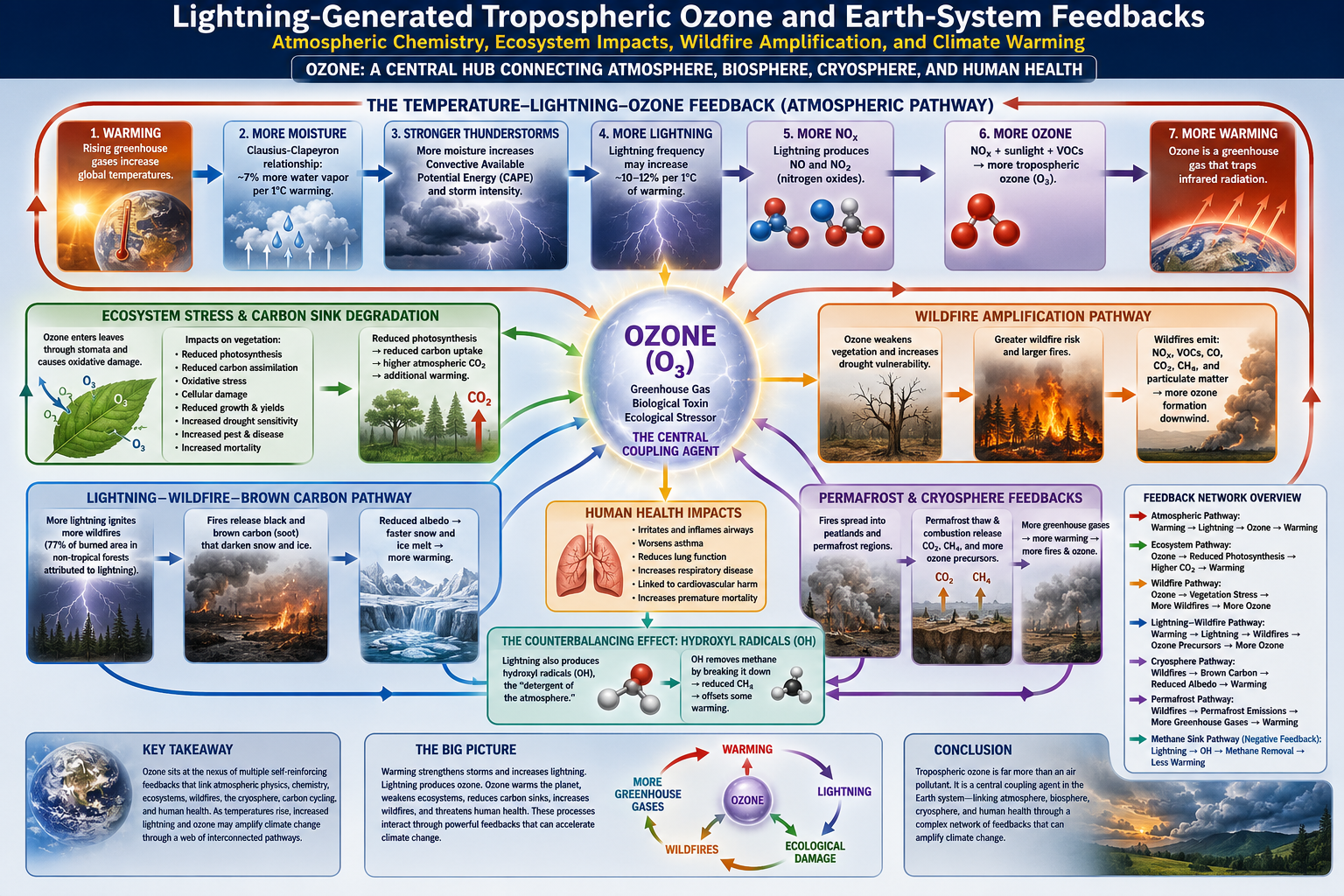
Tropospheric ozone is not merely a byproduct of climate change—it is a critical Earth-system coupling agent that links atmospheric warming, lightning activity, ecosystem health, wildfire dynamics, carbon-cycle disruption, human health, and cryosphere processes into a network of interconnected feedbacks capable of accelerating global warming.
The emerging role of ozone within so many coupled feedback mechanisms illustrates both the extraordinary complexity of atmospheric physics and chemistry and the profound interconnectedness of the Earth’s climate system. Rather than operating through a single pathway, ozone influences climate through multiple atmospheric, biological, ecological, and cryospheric processes simultaneously. It acts as a greenhouse gas that directly contributes to warming, a biological toxin that damages vegetation and weakens carbon sinks, and an ecological stressor that increases vulnerability to drought, disease, and wildfire.
These interactions highlight an important reality of climate change: many of the most consequential feedbacks do not operate in isolation. Instead, they interact, overlap, and reinforce one another across multiple components of the Earth system. As temperatures rise, increases in atmospheric moisture, thunderstorm intensity, lightning frequency, ozone production, ecosystem stress, wildfire activity, and greenhouse-gas emissions can become increasingly coupled, creating cascading feedback loops that amplify climate change beyond what would be expected from any individual mechanism alone.
Understanding these previously underappreciated connections is essential for accurately assessing climate risk. The ozone-lightning-wildfire nexus provides a compelling example of how nonlinear interactions between atmospheric chemistry, ecosystem processes, and climate dynamics may be contributing to the accelerating pace of global warming observed across many Earth-system indicators.
Abstract
Tropospheric ozone (O₃) occupies a unique and underappreciated position within the Earth system. Unlike carbon dioxide, which is primarily discussed as a greenhouse gas, ozone simultaneously functions as a greenhouse gas, a biological toxin, a crop-damaging pollutant, a forest stressor, and a driver of ecosystem degradation. Lightning represents one of the largest natural sources of atmospheric nitrogen oxides (NOₓ), making it a major contributor to ozone formation in the middle and upper troposphere. As global temperatures rise, increasing atmospheric moisture and convective instability are expected to increase lightning activity, potentially creating additional ozone production.
This paper examines the role of lightning-generated ozone within a broader network of interacting climate feedbacks. We argue that ozone serves as a critical coupling mechanism linking atmospheric warming, wildfire activity, carbon-cycle disruption, ecosystem decline, human health impacts, and climate amplification. When ozone-induced vegetation stress, carbon sink degradation, lightning-driven wildfire ignition, brown-carbon deposition, and permafrost emissions are considered together, ozone emerges as a central participant in a complex web of self-reinforcing Earth-system feedbacks.
Introduction
Most discussions of climate change focus on carbon dioxide and methane. Yet another greenhouse gas operates simultaneously as an atmospheric pollutant, a biological poison, and a climate feedback amplifier: tropospheric ozone.
In the stratosphere, ozone shields life from harmful ultraviolet radiation. Near the Earth’s surface and throughout the troposphere, however, ozone becomes one of the most destructive gases in the atmosphere. It damages human lungs, suppresses photosynthesis, weakens forests, reduces agricultural productivity, accelerates ecosystem decline, and contributes directly to planetary warming.
Unlike carbon dioxide, ozone is not emitted directly in large quantities. Instead, it forms through chemical reactions involving nitrogen oxides (NOₓ), volatile organic compounds (VOCs), sunlight, heat, and atmospheric oxidants. While fossil-fuel combustion remains the dominant anthropogenic source of ozone precursors, lightning is among the largest natural producers of atmospheric NOₓ.
Historically, lightning-generated ozone has been viewed primarily as an atmospheric chemistry problem. Increasing evidence suggests that this perspective is incomplete. Ozone may instead represent one of the most important connectors linking climate warming, ecosystem degradation, wildfire activity, carbon-cycle disruption, and human health.
Lightning as a Natural Ozone Generator
Lightning acts as a natural atmospheric plasma reactor.
A single lightning channel can briefly reach temperatures approaching 30,000°C—hotter than the surface of the Sun. These temperatures dissociate atmospheric nitrogen (N₂) and oxygen (O₂), allowing them to recombine into nitric oxide (NO) and nitrogen dioxide (NO₂).
Collectively known as NOₓ, these compounds form the foundation of tropospheric ozone chemistry.
As sunlight interacts with NOₓ and other atmospheric compounds, ozone is produced throughout the hours and days following thunderstorms.
Lightning also generates ozone directly. The electrical discharge can split oxygen molecules into individual oxygen atoms, which rapidly combine with surrounding oxygen molecules to form ozone.
The familiar “clean” smell associated with thunderstorms is, in large part, the scent of ozone itself.
Ironically, the smell many people associate with fresh air is actually the smell of a toxic oxidizing gas.
When inhaled, ozone attacks respiratory tissues, produces oxidative stress, inflames airways, worsens asthma, and contributes to cardiovascular disease. The same oxidative chemistry that damages plant cells also damages human lungs.
Ozone: Greenhouse Gas, Biological Toxin, and Climate Amplifier
Ozone occupies a unique position among greenhouse gases because it operates simultaneously through atmospheric and biological pathways.
Atmospherically, ozone absorbs outgoing infrared radiation and contributes directly to warming. Ozone produced in the upper troposphere is particularly effective because it resides in colder atmospheric layers where radiative trapping is enhanced.
Biologically, ozone functions as a powerful phytotoxin.
When ozone enters leaves through stomata, it initiates oxidative reactions that damage cellular structures and disrupt photosynthesis.
Documented impacts include:
- Reduced photosynthesis
- Reduced carbon assimilation
- Oxidative stress
- Cellular membrane damage
- Reduced crop yields
- Reduced forest productivity
- Increased drought sensitivity
- Increased vulnerability to insects and disease
- Increased tree mortality
Numerous studies have reported reductions in plant productivity ranging from roughly 10% to over 40%, while some highly sensitive ecosystems have experienced substantially larger declines.
Ozone should therefore be viewed not simply as a greenhouse gas, but as a large-scale ecological forcing agent capable of weakening the biological systems that regulate atmospheric carbon.
Ozone and the Weakening of Earth’s Carbon Sinks
Forests, grasslands, wetlands, and agricultural systems remove billions of tons of carbon dioxide from the atmosphere each year.
This natural carbon uptake has historically slowed the pace of climate change.
Ozone directly undermines this process.
As photosynthesis declines, less carbon is removed from the atmosphere and less carbon is stored in vegetation and soils.
The resulting feedback can be summarized as:
Ozone → Reduced Photosynthesis → Reduced Carbon Uptake → Higher Atmospheric CO₂ → Additional Warming
This pathway is especially important because it converts ozone from a short-lived atmospheric pollutant into a mechanism capable of influencing long-term carbon-cycle dynamics.
In this sense, ozone becomes both a greenhouse gas and a destroyer of greenhouse-gas removal systems.
Ozone as a Wildfire Multiplier
One of the most important—and potentially underestimated—roles of ozone may be its influence on wildfire vulnerability.
Vegetation exposed to chronic ozone stress experiences weakened physiological defenses, reduced water-use efficiency, impaired growth, and increased susceptibility to drought.
As warming intensifies heat waves and water stress, ozone-damaged ecosystems become increasingly vulnerable to combustion.
At the same time, wildfires themselves generate enormous quantities of ozone precursors:
- Nitrogen oxides (NOₓ)
- Volatile organic compounds (VOCs)
- Carbon monoxide (CO)
- Fine particulate matter
These emissions can generate ozone hundreds or even thousands of kilometers downwind.
This creates a reinforcing cycle:
Climate Warming → More Ozone → Weaker Vegetation → Greater Drought Stress → More Wildfires → More Ozone
The wildfire–ozone connection transforms atmospheric chemistry into an ecosystem-level feedback capable of accelerating climate change.
Lightning, Wildfires, and Brown Carbon
Climate warming is expected to increase lightning frequency by enhancing atmospheric moisture and convective instability.
Multiple studies suggest lightning activity may increase substantially with continued warming.
This has implications far beyond atmospheric chemistry.
Lightning is already the dominant ignition source for many remote boreal and temperate forest fires. In intact non-tropical forests, approximately 77% of burned area has been attributed to lightning-caused fires.
As lightning increases, wildfire ignition is expected to increase.
These fires release:
- Carbon dioxide
- Methane
- Ozone precursors
- Black carbon
- Brown carbon
Brown carbon and soot darken snow and ice surfaces, reducing albedo and accelerating melt.
This creates another reinforcing feedback:
Warming → More Lightning → More Wildfires → More Brown Carbon → Faster Ice Melt → More Warming
Ozone sits within this feedback as both a product of wildfire emissions and a contributor to the vegetation stress that makes fires more likely.
Ozone, Permafrost, and Cascading Feedbacks
The wildfire story does not end when forests burn.
Increasingly, fires are spreading into peatlands and permafrost regions.
Permafrost was once assumed to thaw gradually over centuries or millennia. Instead, many regions are now experiencing rapid thaw, combustion, and year-round smoldering fires.
These fires release:
- Carbon dioxide
- Methane
- Additional ozone precursors
The resulting emissions accelerate warming, increasing atmospheric instability and lightning frequency.
This creates a larger cascading feedback network:
Warming → More Lightning → More Wildfires → More Ozone and Greenhouse Gases → More Warming → More Permafrost Fire → More Emissions → More Lightning
The interactions become increasingly nonlinear as multiple feedback loops reinforce one another simultaneously.
The Temperature–Lightning–Ozone Feedback
At the center of this network lies a relatively simple relationship.
Warmer air holds more moisture.
More moisture supports stronger thunderstorms.
Stronger thunderstorms generate more lightning.
More lightning produces more NOₓ.
More NOₓ produces more ozone.
More ozone produces additional warming.
The core feedback can be summarized as:
Warming → More Moisture → More Thunderstorms → More Lightning → More Ozone → More Warming
However, this atmospheric feedback is only the beginning.
Once biological and wildfire effects are incorporated, the system expands dramatically.
The Temperature–Lightning–Ozone Feedback
One of the most significant pathways linking climate change to ozone production arises through the relationship between temperature, atmospheric moisture, thunderstorm development, and lightning frequency.
According to the Clausius-Clapeyron relationship, the atmosphere can hold approximately 7 percent more water vapor for every 1°C increase in temperature. As the atmosphere warms, additional moisture becomes available to fuel convection, increasing the intensity and energy of thunderstorms.
Greater atmospheric moisture contributes to higher levels of Convective Available Potential Energy (CAPE), one of the primary indicators of thunderstorm strength. Higher CAPE environments favor stronger updrafts, deeper convection, more vigorous storm systems, and ultimately greater lightning production.
Multiple studies suggest lightning frequency may increase by approximately 10 to 12 percent for every 1°C of global warming, although regional responses may vary. Because lightning is a major natural source of atmospheric NOₓ and ozone production, this relationship creates a potentially important self-reinforcing climate feedback.
The atmospheric pathway can be summarized as:
Warming → More Atmospheric Moisture → More Thunderstorms → More Lightning → More Ozone → More Warming
However, the significance of this feedback extends beyond ozone’s direct greenhouse effect.
Because tropospheric ozone functions simultaneously as a greenhouse gas, a biological toxin, and an ecological stressor, increased ozone production can trigger multiple reinforcing pathways throughout the Earth system. Ozone damages vegetation, reduces photosynthesis, weakens carbon sinks, increases drought sensitivity, elevates wildfire risk, and contributes directly to atmospheric warming. Each of these pathways feeds back into the climate system, potentially creating additional warming that promotes further thunderstorm activity and lightning generation.
Consequently, the temperature-lightning-ozone relationship should not be viewed as a simple atmospheric chemistry feedback. Rather, it represents the entry point into a broader network of interconnected feedbacks linking atmospheric physics, ecosystem productivity, wildfire dynamics, carbon-cycle disruption, and climate change.
In this expanded framework, ozone serves as the critical intermediary connecting warming-induced increases in lightning activity to biological and climatic processes that may further amplify global warming. The resulting feedback network is considerably more complex—and potentially more powerful—than the direct atmospheric warming effect of ozone alone would suggest.
The Expanded Ozone-Centered Feedback Network
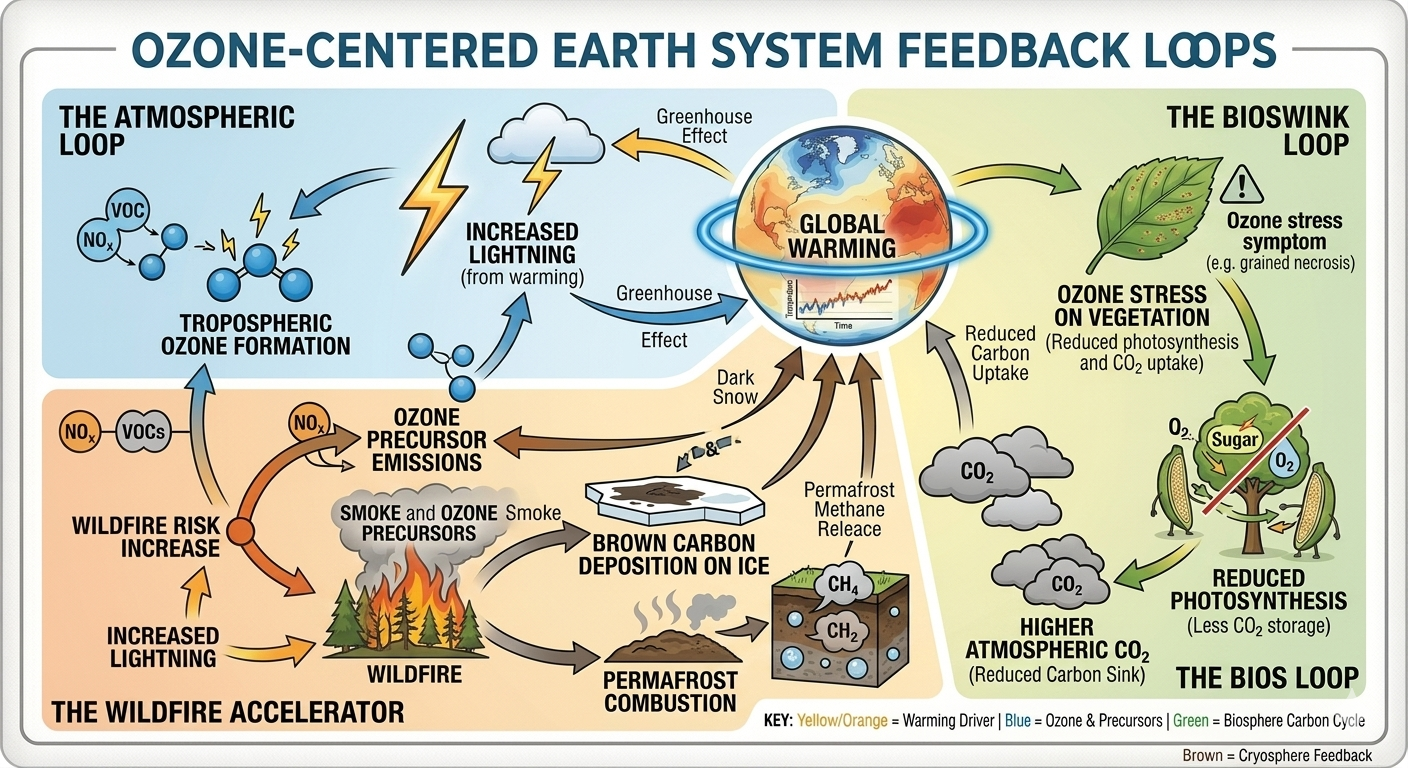
The emerging Earth-system framework can be viewed as a series of interconnected feedback loops centered on ozone:
Atmospheric Pathway
Warming → Lightning → Ozone → Warming
Ecosystem Pathway
Ozone → Reduced Photosynthesis → Reduced Carbon Uptake → Higher CO₂ → Warming
Wildfire Pathway
Ozone → Vegetation Stress → Increased Wildfire Risk → More Ozone
Lightning–Wildfire Pathway
Warming → Lightning → Wildfires → Ozone Precursors → More Ozone
Cryosphere Pathway
Wildfires → Brown Carbon → Reduced Albedo → Warming
Permafrost Pathway
Wildfires → Permafrost Combustion → CO₂ and CH₄ Release → Warming
Together these feedbacks form a coupled network connecting atmospheric chemistry, ecosystem productivity, wildfire dynamics, cryosphere stability, and carbon-cycle feedbacks.
The Counterbalancing Role of Hydroxyl Radicals
Not all lightning-driven chemistry promotes warming.
Lightning also generates hydroxyl radicals (OH), often called the “detergent of the atmosphere.”
Hydroxyl radicals react with methane and accelerate its removal from the atmosphere.
This creates an important negative feedback:
Lightning → More OH → More Methane Destruction → Reduced Warming
This methane-removal pathway partially offsets some warming influences associated with ozone production.
The net balance between ozone-driven warming and OH-driven methane removal remains an active area of research.
Conclusion
Lightning is far more than an atmospheric curiosity.
It is a natural engine of ozone production, and ozone is far more than a conventional air pollutant.
Tropospheric ozone acts simultaneously as a greenhouse gas, a biological toxin, a destroyer of carbon sinks, a contributor to wildfire vulnerability, a threat to human health, and a participant in multiple self-reinforcing climate feedbacks.
Viewed through an Earth-system lens, ozone emerges as one of the most important coupling agents linking atmospheric chemistry, ecosystem degradation, wildfire amplification, carbon-cycle disruption, cryosphere change, and climate warming.
The critical scientific challenge is no longer understanding ozone as an isolated pollutant. It is understanding how ozone interacts with the growing network of feedback loops that are increasingly reshaping the Earth system.
The possibility that ozone occupies a central role in these cascading feedbacks deserves far greater attention as climate change accelerates.
Important Reading:
The Ozone Feedback Theory: Tropospheric Ozone as a Driver of Ecosystem Decline, Carbon Sink Failure, and Climate Acceleration
Ring of Fire Thunderstorm Feedbacks
* Our probabilistic, ensemble-based climate model — which incorporates complex socio-economic and ecological feedback loops within a dynamic, nonlinear system — projects that global temperatures are becoming unsustainable this century. This far exceeds earlier estimates of a 4°C rise over the next thousand years, highlighting a dramatic acceleration in global warming. We are now entering a phase of compound, cascading collapse, where climate, ecological, and societal systems destabilize through interlinked, self-reinforcing feedback loops.
Feedback loops amplify climate change and can push interconnected Earth systems past critical tipping points. As tipping points are crossed, they can trigger additional feedback loops and destabilize other climate systems. This cascading "Domino Effect" compresses timescales, accelerates change, and increases the risk of rapid, nonlinear climate transformations.