Introduction to Singularity
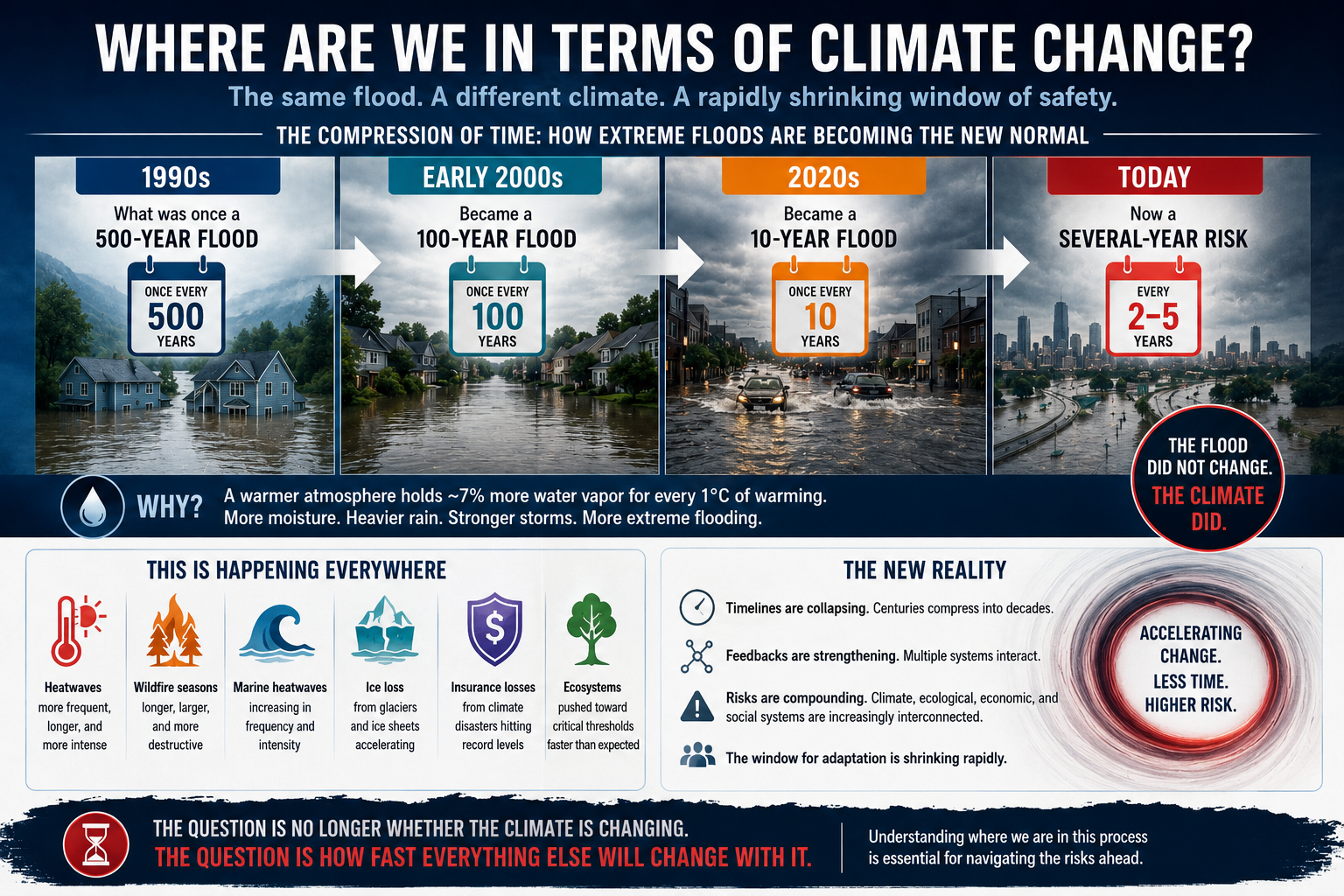
The Compression of Time: Where Are We in Climate Change?
The Compression of Time: Where Are We in Climate Change?
You Are Here.
One of the simplest ways to understand climate change is through the changing frequency of extreme events.
In the 1990s, what was considered a 500-year flood was expected to occur, on average, once every five centuries. By the early 2000s, many of those same events were being reclassified as 100-year floods. By the 2020s, they increasingly resembled 10-year floods. Today, in some regions, comparable flood events are occurring every few years.
The flood itself did not change.
What changed was the climate system.
The same phenomenon can be observed across numerous climate indicators:
- Heatwaves that once occurred once in a generation now occur repeatedly within a decade.
- Wildfire seasons are becoming longer, larger, and more destructive.
- Marine heatwaves are increasing in frequency and intensity.
- Ice loss from glaciers and ice sheets continues to accelerate.
- Insurance losses from weather-related disasters are reaching record levels.
- Ecosystems are being pushed toward critical thresholds faster than many models once anticipated.
The key lesson is that climate change is not simply about gradual warming. It is about the acceleration of change itself.
For decades, scientists and policymakers often discussed climate impacts using relatively stable timelines. Yet as feedback loops strengthen and multiple systems interact, those timelines begin to collapse. What was expected centuries from now may arrive within decades. What was expected decades from now may arrive within years.
The question is no longer whether the climate system is changing.
The question is how rapidly interconnected climate, ecological, economic, and social systems respond as accelerating feedbacks compress the time available for adaptation.
Understanding where we are in that process is essential for understanding the risks that lie ahead.
Given the importance and accessibility of these findings, this work is presented in three formats:
- Singularity: Public Access Version (6th-grade level)
- Singularity: Easy Version (~8th–10th grade level)
- Singularity: Journal-Ready Version (~college graduate level)
Each version conveys the same core insight: complex, coupled systems can shift rapidly from stable to unstable behavior, and understanding this transition is critical to anticipating future climate and economic risk.
Climate and Economic Singularity
(Public Access Version)
Approaching Singularity: Third Derivatives, Nonlinear Collapse, and Coupled Climate–Economic Instability
Daniel Brouse¹ and Sidd Mukherjee²
March 2026
Big Idea
Some systems look stable… until they suddenly aren’t.
In science, a singularity is when our math and predictions stop working well. It might look like things are going to “infinity,” but in real life, that doesn’t actually happen.
Instead, it means:
- Small changes can cause very big effects
- Systems can become unstable
- Things become hard to predict
This paper says that both the climate and the economy are moving toward this kind of point.
Even more important: they are connected.
Each one makes the other worse, creating a loop that keeps speeding things up.
This is like:
- A dam about to break
- A tornado touching the ground
- Water spinning down a drain
They seem fine at first… then suddenly change very fast.
1. What Is a Singularity?
A singularity is not really a single point.
It’s more like a change zone:
- Stable → Unstable
- Predictable → Unpredictable
- Calm → Chaotic
👉 It’s the edge of what we can understand.
2. The Dam Example
Step 1: Looks Safe
- Water rises slowly
- Pressure builds
- Small cracks form
Everything looks okay.
Step 2: Hidden Danger
Pressure grows faster than you expect.
Small increases in water → much bigger stress
Step 3: Breaking Point
At some point:
- The dam is still standing
- But it’s already weak
Then:
👉 One small change → total collapse
Step 4: Collapse Speeds Up
Once it starts:
- More water flows → more damage
- More damage → even more water
This creates a loop:
👉 More flow → more damage → more flow
Key Idea
A dam doesn’t break slowly.
It goes:
Stable → Unstable → Collapse
3. The Vortex Example (Like Water Down a Drain or a Tornado)
When water spins—or when air spins in a tornado:
- The closer you get to the center
- The faster it moves
As you get very close:
- Speed increases very quickly
- Everything gets pulled inward
This is similar to a tornado touching down:
- At first, it forms in the sky
- Then it reaches the ground
- Suddenly, the spinning becomes very strong and destructive
In real life:
- It doesn’t go to infinity
- It becomes wild, chaotic, and damaging
👉 The system stops behaving in a simple, predictable way.
Key Idea
Near the center:
- Small changes → big effects
- Things become hard to predict
4. What This Means for Climate and the Economy
We see the same pattern:
- Things are getting worse
- They’re getting worse faster
- The speeding-up is also increasing
👉 In simple terms:
- Problems are growing
- The growth is speeding up
- And that speed-up is getting stronger
5. The Feedback Loop Problem
Climate and the economy affect each other:
More climate damage
→ more money lost
→ less ability to fix problems
→ more risk
→ even more damage
👉 This is a loop that keeps making things worse.
6. Why This Is Dangerous
As systems get close to this “singularity”:
- Small events can cause big problems
- Predictions become less reliable
- Instability spreads
Examples:
- Dam → sudden collapse
- Vortex → chaos
- Climate → chain reactions
- Economy → financial stress
7. The Most Important Idea
Singularity does not mean infinity.
It means:
👉 Loss of stability and predictability
8. What Happens Next?
If things keep going this way:
- Disruptions happen more often
- Systems become weaker
- Big failures become more likely
Not from one big event…
👉 But from pressure building over time + feedback loops
Final Thought
Singularity is the edge of understanding.
As we get closer:
- Small changes matter more
- Risks grow faster
- Things get harder to control
👉 The real danger isn’t just change—
it’s how fast the change is speeding up.
Easy-to-Read References
-
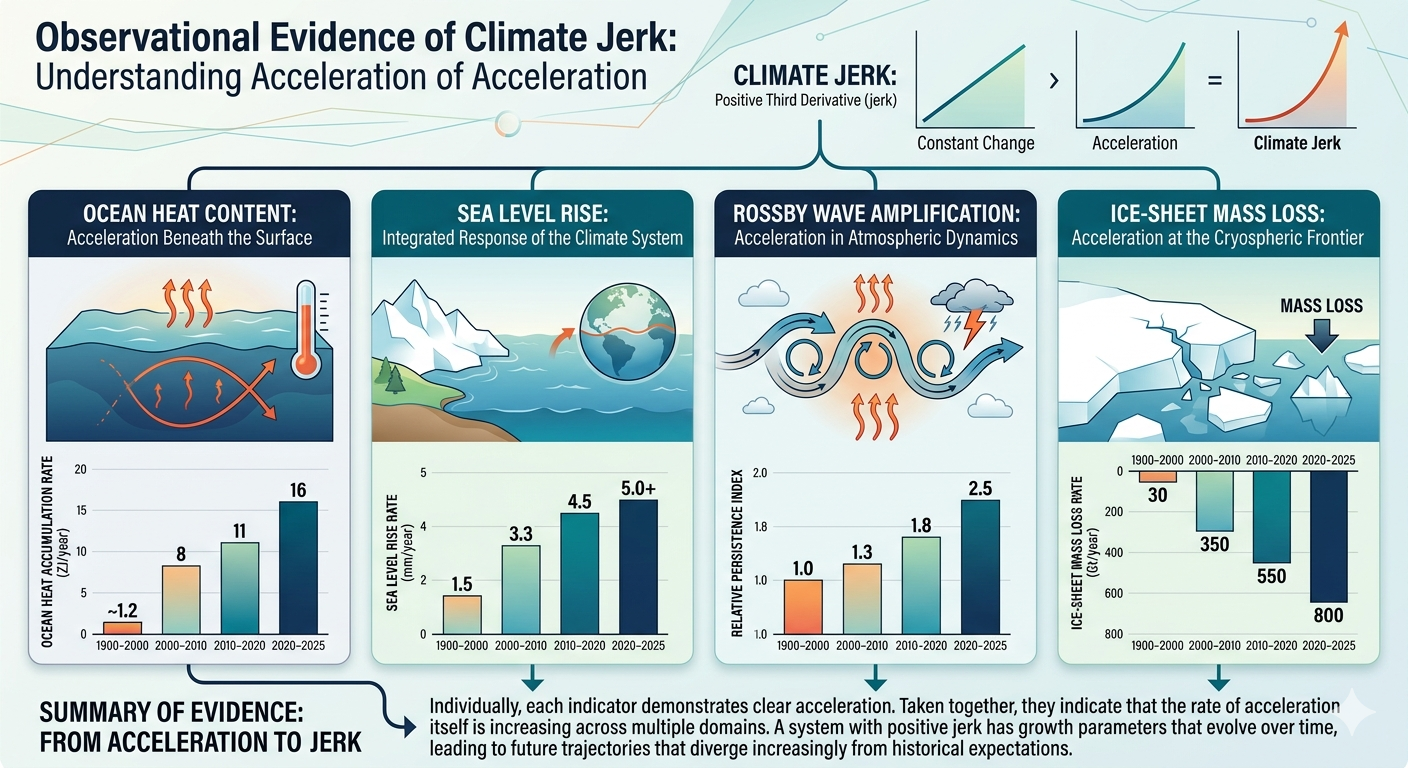
Observational Evidence of Climate Jerk
Third derivative—commonly referred to as “jerk” behavior: ocean heat content, sea level rise, Rossby wave amplification, and ice-sheet mass loss. -
Singularity: The Runaway Guitar Feedback Scenario
Definitions of: runaway climate indicator feedbacks, runaway greenhouse effect, Hothouse Earth, Venus Syndrome, and singularity - The Runaway Train Scenario
- Example: Amazon Rainforest Dieback
References (Simple)
- Observational Evidence for Climate Jerk: Multidisciplinary Indicators of Accelerating Climate Acceleration -- Brouse and Mukherjee
- IPCC – Climate report
- Lenton – Tipping points
- Hansen – Ice melt
- NOAA – Disaster costs
* Our probabilistic, ensemble-based climate model — which incorporates complex socio-economic and ecological feedback loops within a dynamic, nonlinear system — projects that global temperatures are becoming unsustainable this century. This far exceeds earlier estimates of a 4°C rise over the next thousand years, highlighting a dramatic acceleration in global warming. We are now entering a phase of compound, cascading collapse, where climate, ecological, and societal systems destabilize through interlinked, self-reinforcing feedback loops.
Tipping points and feedback loops drive the acceleration of climate change. When one tipping point is toppled and triggers others, the cascading collapse is known as the Domino Effect.